Wonder and Awe – Human Evolution.

Wisdom of the Ages

evolution
evolution6

We were not always alone as we are now. Although we share 99% of our genes with chimpanzees and gorillas, our closest living relatives, we are different. The prime difference being the size of our brains and our intelligence. Once there were a whole host of different humans.

We evolved in the Rift Valley in Ethiopia. We are all of African descent. We are all one species.

The fossil and DNA evidence is conclusive. Racists and creationists have nowhere to hide. All they can do is deny.

A mere five million years ago our common ancestor split off from the chimp line. The Australopithecines had a brain weight of 500 grams (slightly bigger than a chimp). By 1.8 million years ago there were numerous groups of hominids living in the Rift Valley region. We were not alone. They included Homo habilis and Homo erectus.

Life in the Rift Valley was precarious. There was a lot of climatic change.

By 1.4 million years ago only Homo erectus had survived. But their brain size had evolved to 1000 grams.

800,000 years ago Homo heidelbergensis had evolved. Their brain weight had jumped to 1400 grams (comparable to modern man). They gave rise to both the Neanderthals and Homo sapiens.

Homo sapiens evolved with a brain weight of 1500 grams only 200,000 years ago. We lived alongside our close, and more intelligent, cousins Homo Neanderthal until 45,000 years ago.

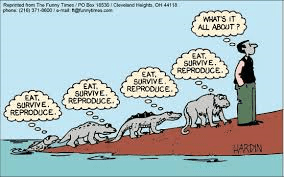
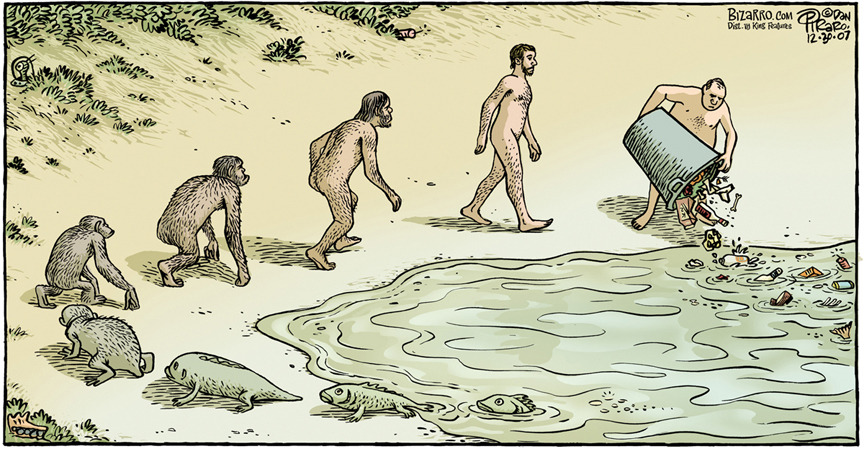
We have only been alone for 45,000 years. What a mess we’ve made of things in such a short time!

We are so new that if you took a baby from 200,000 years ago and brought them up in the present day they could be a nuclear scientist, president or rocket scientist without any trouble. We haven’t changed. Our brains are the same.

I like to imagine that somewhere, in a secluded garden of Eden, hidden away, a group of surviving Neanderthals have set up home. Despairing of the destructive violence of their cousins they cloistered themselves away.

I wonder what they would make of the world we have made and our invention of war, religion, pollution, overpopulation, politics, climate change, cruel ways to kill other animals and enough greed, selfishness and power-madness to destroy the planet.

Perhaps with their wisdom and intelligence they could convince us that there is a better way of living. We could take a lesson from the whales and dolphins. We could be gentle and live in a self-sustaining manner in harmony with each other and the planet.

I hope we find them soon. I’m scared of being alone with the megalomaniacs raging around me.

Poetry – I am a Gorilla

I am a Gorilla

I am a gorilla

In a garden without a single tree

A crazy, bemused chimpanzee

Who built a lavatory.

My madness runs

In my veins and DNA.

Inherited through my genes

To bring atoms into play.

From the African Savannah

Right out to the stars

We’re the naked chimps

Who string up guitars.

I know I am a mad ape

Creating cities and the gun

Fanatical religions

And we’ve only just begun.

Opher 15.8.2015

I am a Gorilla

We haven’t been around so long and yet we’re running the planet. We’re out of control.

We think we’re so clever but look at the mess we’re making of things!

We can be so kind but we are the cruellest animal who ever evolved.

We run on power.

We desire more.

We fight for much more than we could ever need.

Our greed is extraordinary. We’re like wolverines in a chicken-run.

The planet’s become our play thing.

And we’ve only just begun!

Water or Savannah Apes? Where did humans evolve from?

Water or Savannah Apes? Where did humans evolve from?

As you can imagine the debate is getting heated. After Attenborough did his programme on humans evolving from marine apes the conservative human evolution establishment is up in arms. They do not like their current theory being challenged.

Human beings evolved from apes in the Rift Valley area of Africa about two million years ago. Not many, apart from the flat-eithers and creationists, are disputing that. We have the fossil evidence.

It is widely believed that we became bipedal on the African savannah in order to hunt and hold tools. The development of intelligence, along with binocular sight and the opposable thumb, necessary for tool manipulation, is well documented.

What David suggested was that we did not become biped on the savannah for hunting but developed this from wading in water to live off molluscs.

So what is the evidence for our aquatic past?

a. Evidence that primitive man ate a lot of bivalves

b. We have blubber (a thick layer of fat under the skin)

c. Babies are born with an immersion syndrome. They naturally hold their breath and can swim under water.

d. We have a physiological change when immersed. Our peripheral blood system shuts down and there are changes in metabolism and brain activity.

e. The hair deposition is of an aquatic animal.

f. We have an affinity for water. We love it.

It is an interesting idea. I look forward to seeing where it goes.

Humans and why we’re not evolving.

Humans and why we’re not evolving.

DSCF1549

Humans and why we’re not evolving.

It is unlikely that we are evolving much at present. We have removed most of the selection pressures that cause evolution. Our amazing brains have produced science and technology that have removed much of the Natural Selection that operated on our populations in the past – at least in the developed countries and increasingly in the undeveloped ones.

We have:

  • Killed off predators
  • Conquered most diseases that would previously have killed us off before we had a chance to breed
  • We have improved sanitation and clean water
  • We have gained a secure food supply.All that is killing us off early is war, accidents and selfish greed.However there is some evolution. The fact that some people choose not to have children while others have many will, in time, skew the numbers of genes in the population. Is it a worry that it is the least intelligent and least educated that are reproducing most? Probably in the long term, if it is a trend that continues. Education is probably the answer to that one.Overpopulation will lead to war, food shortage and disease. Probably a new virus will emerge to which we have no resistance. Only those with a mutation that provides immunity will survive – or maybe nobody.The only difference between all of them and us is that we will be the first to do it to ourselves through our own greed, arrogance and foolishness. So much for intelligence. Without other qualities it counts for little.Time will tell.
  • So will we evolve? Be a blip? A tiny layer in the strata of time?
  • Science has demonstrated that 99.9% of all animals that have evolved have passed into extinction.
  • But this state of affairs is a blip. It will not last. Soon the selection pressures will return with a vengeance. Our numbers have grown out of proportion and our intelligence will not outdo the threats.
  • 95% of us survive long enough to have children.

The most likely selection pressure will be a virus – though we could find ourselves victims of our own greed as we destroy the natural world on which we depend. We could precipitate a disastrous climatic change or even a radical change in our atmosphere.

The Evolution of Humans

The Evolution of Humans

brain

The Evolution of Humans

Hominids first evolved out of ape-like creatures in the Rift Valley in Africa only 7 million years ago. There have been a multitude of species of subhuman apes. Modern man with his brain-size and thinking power only evolved a mere two hundred thousand years ago. That is the blink of an eye.

The sub-human hominids all died off but for much of our short history we shared the planet with another human species. The Neanderthals, wrongly represented as brutal cavemen, had bigger brains than ours and were probably more intelligent. They certainly had culture and made tools. They were wiped out quite recently. We don’t know if that was through disease, climate change, competition with us or differences over religion. Maybe they came up against an early form of ISIS and were just too kind and nice?

It is a great shame that there aren’t other species of intelligent humans surviving to this day. It would have taken the wind out of religion. It’s hard to be the chosen species when there are more than one. But then I suppose the religious manage to do just that on a tribal basis.

It is only sixty thousand years ago that we migrated out of Africa (and now we’re doing it again) but look at what we’ve done!! We’ve gone from a handful to 7 billion in no time at all.

We think we are here for ever. We think we have removed selection and are immune. We are arrogant enough to think that we can do anything and survive.

But can we?

Was the Agricultural Revolution a Disaster for Both Humans and Other Life??

The Agricultural Revolution took place a mere 12,000 years ago. Was it the biggest mistake we ever made?

In 10,000 BC there were only beween 5-8 Million human beings on the planet. They were all hunter-gatherers. They ranged over large areas and enjoyed a varied diet and complex lifestyle. They were nomadic and had few possessions.

The standard view of this life is that it was hard but, according to Harari, that misses the point. There were undoubtedly hardships, times of plenty and times of shortage, physical dangers and no room for frailties. There was much complexity, many skills and much knowledge required.

According to Harari hunting and gathering actually only took around 35 hours a day leaving plenty of time for other activities.

Ten thousand years later the numbers of hunter-gatherers had reduced to 1-2 Million but there were 250 million farmers. A great success!! Or was it?

Certainly our numbers greatly increased – farming could support a far greater number of people than hunter-gathering.

Now families had possessions, homes and protection against the elements and predators. But was that good?

  • Our diets were greatly restricted to a few crops
  • There was much work to be undertaken, preparing soil, planting, reaping, storing, irrigating. The working day greatly increased and was concerned with hard work
  • There was much worry about the future – weather, flooding, drought
  • There was a need to protect crops from animals – it had to be fenced and guarded
  • There were now stores and possessions that could be stolen and needed protecting
  • There were many people living close together promoting diseases
  • Proximity to animals created transfer of disease into human communities
  • More children were born (but many died) creating larger populations which could no longer be sustained by hunter-gatherer living. There was no way back.

Human being were now locked into a lifestyle that was hard, full of worry and nowhere near as rich as before.

The fauna of the planet had already suffered a massive wave of extinctions following the cognitive  revolution. At the time of the Cognitive Revolution there were over 200 species of Megafauna weighing over 50 kilograms – including Mastodons, Mammoths, Giant Sloths, Elephant Birds, Giant Lemurs, Giant Koalas, Giant Kangaroos, Giant Lions, Giant Beavers, and many more. By the time of the Agricultural Revolution there were already less than a 100. Where-ever mankind ventured the megafauna were the first to go.

The Agricultural Revolution was the start of the second major wave of mass extinctions as habitats were destroyed and wild animals killed to prevent them damaging or eating crops.

Perhaps we should have stayed as hunter-gatherers, kept our numbers down and led a more fruitful life?


The Future for Humans – Homo superior – it’s just round the corner.

I was reading Homo Deus and peering into the future. What I was glimpsing was the Super Human – Homo superior.

This was a new race a much greater jump than Australopithecine to Homo sapiens. People with IQs that soar far above anything we can presently imagine. Compared to them our geniuses will be morons. They will have a physique and metabolism to go with it.

It will happen. It is not far off.

This will not happen through the slow uncertain process of evolution. Nothing so perfect could possibly come out of that laborious process. Our present imperfect bodies and minds are the result of that. No. It will not be evolution.

Neither will it even be through the cumbersome process of selective breeding and ethnic cleansing as envisioned by the likes of Adolf Hitler and the eugenics movement. The limitations of that are obvious.

No – these amazing mutations will be the result of our genetic manipulation and mastery of the genome.

The changes from apes to humans were due to very few mutations in our DNA. Back on those African plains those tiny changes transformed us from scavenging apes to become masters of computers and space craft.  Just think what a scientist could achieve with a few hundred well thought out tweaks to our DNA.

Once we have the ability to insert genes or alter DNA – once we fully understand how gene expression works – once we are masters of the genome – we will be able to manipulate the human genome, eradicate the faults and create whatever skills and attributes we wish. There will be no limits. We will be able to design the ideal human – Homo superior – the super human – unlimited intelligence, perfect health, a metabolism that zings and a body to die for.

And believe me – we will die out. The time of Homo sapiens will be over. We will be replaced more quickly than you can say Neanderthal – or maybe we’ll be kept as pets?

We might try to stop it happening – but you can bet someone, somewhere is already working on it.

Roll over Beethoven – dig these genes and news.

Water or Savannah Apes? Where did humans evolve from?

As you can imagine the debate is getting heated. After Attenborough did his programme on humans evolving from marine apes the conservative human evolution establishment is up in arms. They do not like their current theory being challenged.

Human beings evolved from apes in the Rift Valley area of Africa about two million years ago. Not many, apart from the flat-eithers and creationists, are disputing that. We have the fossil evidence.

It is widely believed that we became bipedal on the African savannah in order to hunt and hold tools. The development of intelligence, along with binocular sight and the opposable thumb, necessary for tool manipulation, is well documented.

What David suggested was that we did not become biped on the savannah for hunting but developed this from wading in water to live off molluscs.

So what is the evidence for our aquatic past?

a. Evidence that primitive man ate a lot of bivalves

b. We have blubber (a thick layer of fat under the skin)

c. Babies are born with an immersion syndrome. They naturally hold their breath and can swim under water.

d. We have a physiological change when immersed. Our peripheral blood system shuts down and there are changes in metabolism and brain activity.

e. The hair deposition is of an aquatic animal.

f. We have an affinity for water. We love it.

It is an interesting idea. I look forward to seeing where it goes.

Poetry – There was a time – a poem about the plastic universe we are creating with our teeming billions.

IMG_2537

There was a time

Locked within our cities far away from the natural world we live a life of safety and synthetic joy. Our whims catered for, our dreams indulged, we are saturated in control.

Our actions are restrained.

Yet how could it be otherwise?

There are now seven billion of us. We have swamped the world like a bacterial scum that erodes all it touches. Trees fall, nature flees, and animals are consumed. Behind us the machine creates the plastic comfort and ease.

Yet no more do we taste the free air and live as brightly. This is the age of health and safety, longevity, and false fulfilment.

This is the plastic, sterile bowels of existence.

There was a time.


There was a time when we ran free,

To pit our wits

And use our ingenuity;

Free of man-made laws,

Of household chores and social mores –

A child in the wild.


Exultant on the trails of beasts

Imagining the feasts

Full of the adrenalin of the hunt

The brotherhood and trust

Unfettered –

With unbridled lust.


Free in the elements –

Every breeze is tasted,

All nuance noted,

Every caress relished,

Every flavour promoted.


Overpowered by the desire for comfort

Security and ease.

The love of many children

Has brought us to our knees.

With seven billion progeny

We are no longer roaming free.

The breeze is tainted

Each caress a travesty.


Secure in our comfort

We’ve lost our sanity.


Opher 31.12.2015

Human evolution – It was the cows wot done it!

DSCF1548

Human evolution – It was the cows wot done it!

As hunter/gatherers our diets were varied but dependent on the success of the hunt. We needed the protein from the meat but hunting was precarious and difficult. Life was hard and lived on the dge. There were times of famine.

Then we had the brainwave of farming. ‘Why go off hunting the buggers when we can capture a couple and breed ‘em up so that they’re easy to get and always available’, and ‘Why go out gathering the stuff when it’s hard to find and spread out? Why not sow some seeds and get it all to come up in one place and there’s lots of it?’ Intelligence is wonderful.

But even that did not solve our problems. The crops grew in season. There were gluts and shortages. Storage was hard. There were still periods of starvation.

We had evolved to digest milk as babies but lost the ability in adulthood.

Natural selection weeded out the starving.

But now there was milk available and you could make butter, cheese and yoghourt if only it didn’t make you sick and you could digest it.

There was a mutation in a gene for lactose tolerance. It enabled adults to digest milk. The ones with the mutated gene had added nutrition through winter and their survival rates rocketed.

They were selected.

Nowadays we can see the prevalence of this gene. It is throughout populations in Europe and Asia.

It is an example of human evolution.

The Sci-fi novels assume the big evolutionary changes will be in intelligence. There is no reason why it should. It will only be beneficial if it gives a clear advantage. The most likely evolution in humans will be a mutation that affords resistance to a disease. Intelligence will count for nothing.

We owe our present success in temperate regions to cows and milk.

It is the cows wot done it!