Photography – Elvis Statue on Beale Street – Memphis
Beale Street was where it all happened – Blues R&B and Rockabilly. It was the Black part of Town. Most of it has been pulled down and redone. It was a very dangerous area with prostitutes, gambling, dancing, gangsters, drugs and lots of knifings and shootings. Life was cheap. But it was the place to hang out where the music was hot, there was wild dancing and plenty of booze.
It’s a bit of a tourist trap now and has been cleaned up. But there is still a lot of loud music and booze and I’m sure you could get yourself shot if you tried.
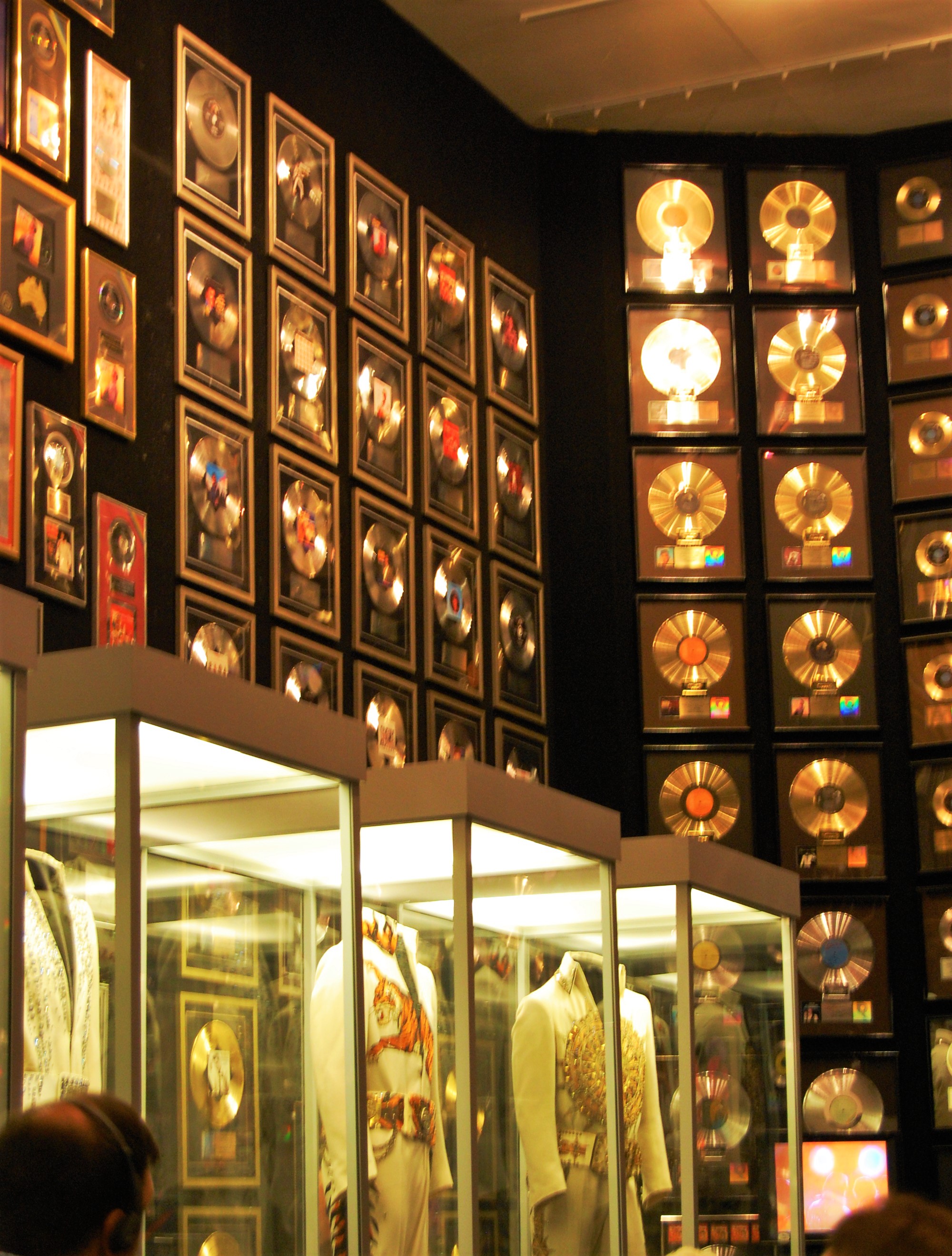
This is the Elvis I love – the Hillbilly Cat. I don’t go for that later period with the glitzy rhinestone. I think he rapidly became a parody of himself.
One day Vernon came home and told Elvis about this horrendous tacky furniture he had seen in a department store. It was Hawaiian with dreadful carving of heads and faces. There were big pieces of furniture -very imposing and ugly. He thought they were the worst thing he’d ever seen and could not believe they had it for sale.
Elvis waited for Vernon to go to bed and rang up the store owner. He arranged for the furniture to be delivered and arranged in the room.
The next morning Vernon came down to find the Jungle Room set up with all that garish furniture.
Elvis had a sense of humour.
They grew to like it and Elvis had the waterfall put in. They called it the Jungle room and he often used to sit in their and jam with his band.
The first album that I bought was a second hand copy of Here’s Little Richard. I adored it and played it to death. I remember at a school fete where we were asked to put on a fund raising stall. I took my Dansette in and was a Juke Box for the afternoon. I only took one album in and that was Little Richard, but I played it non-stop all afternoon and made a pound or two. It was an excuse to play the stuff I loved extremely loudly.
I soon followed that first album with Eddie Cochran and Buddy Holly. I extended out to Elvis Presley and the first Cliff Richard ‘Live’ album.
The first new album I bought was The Shadow’s Greatest Hits in summer 1963. I loved the Shadows and had all their singles. It seemed the logical choice. I wasn’t to know that no sooner had I bought it that it was destined to become part of the ‘old sound’. It was blown into the past by the Beatles.
After one hearing of the Beatles Please Please Me album I was hooked. I rushed out and bought it. For a full year Merseybeat was it. Then it was British Beat with the Stones, Kinks, Who, Yardbirds, Animals and Pretty Things. I still have all the singles and albums. But I craved for the slightly out of the ordinary so I had The Downliners Sect, Birds, Sorrows and Bo Street Runners. I felt that this was my music. This was as if a knife had sliced it off from everything that had gone before. This was mine.
I loved albums.
I rushed home to my bedroom with my latest purchase, put side one on the Dansette and while it was blasting out, to the distant sound of ‘turn that down!’ futilely coming from my mum and dad in the living room, I avidly digested the front cover photo and all the writing and songs on the back. It was a total experience.
LPs were sacred. They were a complete package of art, information and music aimed only at me. I absorbed them with the rapture they deserved. They were the total immersive experience.
Rock Music Genres – Skiffle – a seminal British scene in the fifties.
Skiffle – British 1950s
Skiffle was a term that came over from Black slang in the fifties. It referred to the type of party where music was played and a hat passed round to reward the musicians.
In the post-war period of the fifties things were still bleak in Britain. The cities had been heavily bombed and every street was littered with bomb-sites. There was still rationing, shortages of clothes and austerity. But the war was over and the kids wanted to get out and enjoy themselves. This was the age before TV. Houses just had a radio and, if you were very lucky, a record player which played 78s.
While the States, who had largely escaped the devastation that had ravaged Europe, was enjoying a boom; where the kids were cruising in cadillacs, listening to Rock and R&B and going to drive-ins, we were having a much harder time.
In the States the intelligentsia was getting into Kerouac, Beat poetry and Zen. In Britain it was Trad. Jazz and CND marches.
Chris Barber was one of those Jazz men and he had a liking for the blues. So much so that he brought some of the blues singers over to Britain and introduced British audiences to the real blues. This paved the way for Cyril Davies and Alexis Korner to set up their R&B band Blues Incorporated. So you could say that Chris Barber was the father of the whole Rock scene. He was also the inaugurator of Skiffle.
Chris was a purveyor of authentic New Orleans Jazz and one of the best. But in the interval he allowed a little offshoot of the band to do a slot. They were a pared back group of musicians with basic guitar, bass and snare who did a series of American Folk-Blues numbers by the likes of Leadbelly, Sonny Terry and Brownie McGhee and even Woody Guthrie. They proved popular.
At a recording session Chris Barber had a bit of time to kill and allowed the Skiffle group led by Lonnie Donnegan to record a few numbers. The rest is history.
One of the tracks got some airplay and the response was so strong that it was released as a single ‘Rock Island Line’, a Leadbelly number, soared straight to number one and started a country-wide craze. Lonnie Donnegan, who had taken his name from the blues singer Lonnie Johnson, was more popular than Elvis.
The beauty of Skiffle was its simplicity. You only needed two chords and it could be largely played on homemade instruments. You needed your mother’s old washboard with a few thimbles, a tea-chest and broom handle bass, and an old beat-up guitar and you were away. All the lads wanted to be in a band and get the girls. Every town sprouted Skiffle Groups and venues. The country might have been poor but it came alive.
It proved a short-term craze. Lonnie had a number of hits and was joined by the Vipers, Chas McDevitt and Nancy Whiskey and a few others and it was over.
Lonnie branched out into novelty songs and Skiffle passed into history. Except it didn’t. The importance of Skiffle wasn’t just in the music and hits it had produced. It had got a whole generation of kids into music and opened up a lot of clubs. Those Skiffle bands learnt more chords, got better instruments and went on to form the Rock and R&B bands that were going to form the Mersey and Beat bands of the British Invasion. The kids had been attracted in, got a taste for performing, had the venues to get up on stage and never looked back. Without Skiffle there might not have been a British Beat boom or an interest in blues.
The Beatles were typical. They started off as the Quarrymen Skiffle group before heading into Rock ‘n’ Roll and R&B. Guitar gods like Jimmy Page were the same. Skiffle was transformational.
Just goes to show! Life is changed by the smallest things. If Chris had not had a bit of extra time on the recording session, or had not liked blues and given Lonnie a chance, history would have been different.
Singer Elvis Presley performing on stage in Hollywood, California. June 22, 1956 Hollywood, Los Angeles, California, USA
Rock ‘n’ Roll emerged as Rockabilly in the mid fifties. In some ways the advent of Rockabilly was the story of Elvis Presley but in reality he was the catalyst and catapult that sent the style stratospheric. The sound had been bubbling around for a few years just waiting for the right person and the right moment. Elvis hit the spot and brought it together. It probably would have coalesced without him but it wouldn’t have been the same.
Rockabilly was the merging of two quite separate styles – black R&B and white C&W. The imposed segregation of the southern States had created a separation of the musicians and styles. Both had developed in their own way to fulfil a need. Following the Second World War there was a change in mood. The country wanted good-time dance music. They’d had it during the war with the Swing Bands. The dance-halls had resounded to the bid-band style as the young people jitter-bugged and lindy-hopped. The black youth seemed particularly adept and the black GIs had certainly impressed the British girls during the war.
As with so many things there was a convergence from many different directions. Elvis happened to emerge as the focus.
There is much conjecture as to the first authentic Rock ‘n’ Roll recording. The fact is that there probably wasn’t one. The term ‘Rock ‘n’ Roll’ had been in use since the thirties in black slang where it was a euphuism for sex. It was used in a number of Black R&B records in the forties. Rockin’ was also used to denote something was really jumping.
The musical elements of Rock ‘n’ Roll were also coming together in a number of different styles simultaneously. As early as 1946 Arthur ‘Big Boy’ Crudup had recorded ‘That’s Alright’ and ‘So Glad You’re Mine’ as up-tempo electric Blues and Bill Monroe recorded his bluegrass version of ‘Blue Moon of Kentucky’. Louis Jordan was developing his electric Jump Blues band style with dance numbers like ‘Let the Good Times Roll’ in 1946 and the ‘Saturday Night at the Fish Fry’, with its chorus of ‘It was Rockin” in 1949. In 1947 Amos Milburn recorded ‘Down the Road Apiece’ and the following year ‘Chicken Shack Boogie’. Hank Williams, with his Honky-Tonk style, recorded ‘Move it on Over’ as early as 1947. The Jump-Blues experts had really begun to put the components together by 1947 when Roy Brown wrote and recorded ‘Good Rockin’ Tonight’. This was covered by Wynonie Harris who also recorded numbers like ‘All She Want To Do is Rock’ in 1949 in the new up-tempo Rock style. This was joined by Goree Carter who released ‘Rock Awhile’ and Jimmy Preston ‘Rock the Joint’. Before the fifties had even begun there was a whole plethora of ‘Rock’ songs coming from Boogie Woogie, Bluegrass, Honky Tonk, Blues and Jump Blues. But the earliest contender of all may well be Sister Rosetta Tharpe, with her electric guitar and the Gospel song ‘Rock me’ incredibly recorded in 1942!
The scene was set for the fifties with segregated audiences, radio stations and ‘Race’ records. It was ripe for a coming together.
Young white audiences were getting hip to the great sounds coming out of the black radio stations. They were digging the Jump Blues, Doo-Wop and Boogie Woogie they were hearing. Black kids and musicians were also tuning in to the white Country stations and liking what they were hearing. It only goes to show that you may segregate the bodies but you can’t segregate the minds.
In the fifties the Blues had electrified and taken on a heavy beat with Muddy Waters and Howlin’ Wolf, Elmore James and co. In Louisiana the R&B sound had come together with Fats Domino and Clarence ‘Frogman’ Henry. In 1950 Fats Domino released ‘The Fat Man’. Hank Williams and Bob Wills were producing up-tempo Country Music.
In 1951 Jackie Brenston, with the Ike Turner Band, released what some say is the first Rock ‘n’ Roll record with ‘Rocket 88’. In 1954 Joe Turner released ‘Shake Rattle and Roll’. You could even make the case for Bill Haley being the first white Rock ‘n’ Roller. He released Rock songs like ‘Rocket 88’, ‘Rock the Joint’ and ‘Rockin’ Chair on the Moon’ in 1951 and 52.
The ingredients were all there. The audience was eager. The times were right. The kids were looking for excitement, something different to their parents. Even the films were reflecting the age of rebellion with James Dean and Marlon Brando. The TNT had been put together all that was needed was the match.
That’s where Elvis came in.
In 1953 he walked into Sun studios in Memphis and made a demo. That young Elvis had been exposed to it all and had absorbed it like a sponge. He was full to bursting. In 1954 Sam Philips put him with two trusted musicians in Scotty Moore on guitar and Bill Black on Bass. The result was a series of searing tracks that created Rockabilly. The trio had no drums but created a driving, fast sound that drew on the R&B and C&W songs that Elvis was familiar with. He breathed a life into them that transformed them into something more. ‘That’s Alright, Mama’, ‘So Glad You’re Mine’, ‘You’re a Heartbreaker’, ‘Shake Rattle & Roll’, ‘I forgot to Remember to Forget her’, ‘Let’s Play House’, ‘Hound-dog’, ‘Mystery Train,’ ‘I forgot to Remember to Forget’, ‘Blue Moon’, ‘Blue Moon of Kentucky’, ‘Good Rockin’ Tonight’, ‘Milkcow Blues’ and ‘I’m Left, You’re Right, She’s Gone’ formed the basis of his live act and most were recorded for Sun. They were joined with some crooning ballads like ‘I Love You Because’ and the legend was off the ground.
Elvis was not only a great singer but also a brilliant performer. Elvis had the style that fashioned a revolution with his greased back long hair, long sideburns, duck-tail, contrasting bright jackets, shirts and ties, tight trousers, and smouldering looks – he had animal magic and charisma. He was incredibly good looking and moved his body sensuously in a way that nobody had seen. It was a mixture of dancing, posing, acting and raw sex with the fluidity of a large cat. It drove the girls crazy. He was called ‘Elvis the Pelvis’ because of his sexual gyrations. He also drove the parents and establishment into paroxysms of shock. Elvis was bringing the sexual vulgarity of black R&B into the white sitting room. The effect on their daughters was all too obvious. They were appalled. He was promptly banned.
However, the genie couldn’t be put back in the bottle. There was too much money to be made.
Every record label in the land was hunting for its own Elvis and the doors were even opened for the Black Performers.
From Sun Studios we got Jerry Lee Lewis, Carl Perkins, Roy Orbison, Billy Lee Riley, Sonny Burgess and Johnny Cash. From Chess in Chicago we had Bo Diddley and Chuck Berry. From New Orleans Fats Domino and Little Richard. From Texas Buddy Holly. Then there was Eddie Cochran, Ray Charles, Gene Vincent, The Everly Brothers, Wanda Jackson, and Dale Hawkins. It was like they all emerged ready-made. They exploded into the charts and a new age was born.
Allan Freed coined the term ‘Rock ‘n’ Roll on his ‘Moondog – Rock ‘n’ Roll’ Show. He championed R&B, Doo-Wop and Rock ‘n’ Roll. Was among the first to play it and organised the first Rock ‘n’ Roll concerts.
Elvis moved from Sun to RCA and took Colonel Tom Parker as his manager. For a couple of years we had the new Rock ‘n’ Roll complete with drums. The trio was ditched, the Jordinaires were used as vocal backing and then Elvis was eased over into a series of mediocre films and conscripted into the army. He had his hair and sideburns shaved and Lennon remarked that they cut his balls off with it.
By 1960 Rock ‘n’ Roll was through. The establishment had been horrified and quick to act. They thought it had a bad effect on the morality of youth and created delinquents. The authorities effectively shut it down using the ‘Payola’ scandal as an excuse. Radios were no longer allowed to play it. The TV stations moved over to the new ‘clean-cut’ boy next door, nicely presented in suits with trimmed hair Philadelphia Pop-Rock of Fabian, Bobby Vee, Bobby Darin and Bobby Rydell.
Chuck Berry was in prison. Elvis was in the army. Little Richard had discovered religion. Buddy Holly and Eddie Cochran were dead. Gene Vincent was badly injured. Jerry Lee Lewis was banned and ostracised because of his marriage to his thirteen year old cousin. Fats Domino had his records covered on the day of release by the clean-cut Pat Boone.
The energy and revolution petered out. Rock ‘n’ Roll was dead.
I visited Memphis and went to Sun Studios. It hadn’t changed. The ceiling was still up and down. They still had the old microphones. I stood on the very spot where Elvis had recorded ‘That’s Alright Mama’, all those years before. You could sense the energy and history.
It was incredibly nostalgic. My greatest regret is that Elvis didn’t have the self-confidence to reject Colonel Parker and the money, to turn his back on the films, and to stand up as a real angry James Dean rebel and stay with his music and his original trio. He rolled over. He watered his music down, tamed his act and became a parody of himself. He should have stayed true.
I was particularly smitten by the similarity between Doo-Wop and the African tradition of acapella groups. In Africa it goes right back to its tribal roots with groups of young men, shuffling, swaying and stamping in rhythm and singing in harmony without any instrumentation. I saw this on many street corners as I went around in Cape Town. It was interesting to see how the tradition was continued in black America in the 1950s. It was common to find groups of youths on street corners doing a similar thing.
As there were no instruments the voices were used to provide that backing. As the main singer gave vent the rest of the group harmonised with bass and harmony and largely nonsense words and sounds to create an intricate arrangement. The term Doo-Wop was not really applied to the style until the end of the fifties. Before that it was seen as another R&B style.
The popularity of the style was obvious. Young blacks suffered a lot of unemployment and there was little money. They had time, talent and no instruments. It was something you could do creatively with your friends that got you attention from the girls, respect from your friends and had the potential to earn money.
It first started up in the 1940s in cities like Chicago and New York and soon became a phenomenon. The earliest successful groups were the Ink Spots and Mills Brothers who, along with others, took it into the charts in the late forties and even reached white audiences and had television exposure.
In the early fifties there were a whole range of Doo-wop groups with names based on birds such as the Ravens, Orioles, Swallows, Robins, Flamingoes, Larks and Penguins. Some of the harder R&B groups had more instrumentation and a touch of Rock as with the Clovers, Hank Ballad and the Midnighters, the Cadillacs, Impalas and Bill Ward and the Dominoes.
By the end of the fifties it was having great success with bands like the Platters, Little Anthony and the Imperials and Frankie Lymon and the Teenagers.
It was incorporated into the Rock scene along with other R&B and elements of Doo-wop regularly find their way into Rock Music as with the backing on many Roy Orbison songs.
The style went on to develop with the highly successful Coasters and Drifters and even into the sixties with the Four Tops.
Other minority groups got in on the sound with Hispanic and Italian groups leading the way. Groups like Dion and the Belmonts and Frankie Valli and the Four Seasons.
Doo-Wop has played a big part in the evolution of Rock Music.
Chuck Berry – Too Much Monkey Business – Protest in Rock ‘n’ Roll.
Chuck was the poet laureate of Rock Music. This was as good a Protest Song as any from Dylan. It’s full of Social Comment and it rocks.
Chuck was a genius. It was a great shame he was shafted by the establishment. They shut him up, locked him up and ripped him off.
Clearly speaking out is not tolerated.
Too Much Monkey Business
Runnin’ to-and-fro – hard workin’ at the mill.
Never fail in the mail – yeah, come a rotten bill!
Too much monkey business. Too much monkey business.
Too much monkey business for me to be involved in!
Salesman talkin’ to me – tryin’ to run me up a creek.
Says you can buy now, go on try – you can pay me next week, ahh!
Too much monkey business. Too much monkey business.
Too much monkey business for me to be involved in!
Blond hair, good looks – tryin’ to get me hooked.
Want me to marry – get a home – settle down – write a book!
Too much monkey business. Too much monkey business.
Too much monkey business for me to be involved in!
Same thing every day – gettin’ up, goin’ to school.
No need for me to complain – my objection’s overruled, ahh!
Too much monkey business. Too much monkey business.
Too much monkey business for me to be involved in!
Pay phone – something wrong – dime gone – will hold
I ought to sue the operator for spinning me a tale- ahh!
Too much monkey business. Too much monkey business.
Too much monkey business for me to be involved in!
Been to Yokohama – been fightin’ in the war.
Army bunk – Army chow – Army clothes – Army car, aah!
Too much monkey business. Too much monkey business.
Too much monkey business for me to be involved in!
Workin’ in the fillin’ station – too many tasks.
Wipe the windows – check the tires – check the oil – dollar gas!
Too much monkey business. Too much monkey business.
Don’t want your botheration, get away, leave me!
TOO MUCH MONKEY BUSINESS FOR ME!!
The real Elvis was the Sun Elvis – the natural Nashville Hillbilly Cat, the Memphis Flash. He had original style, energy and was innovative. The contrasting clothes, the quiff, the ducktail and sideburns, the way he moved.Those early Sun recordings were superb and life changing.
Then came Parker the killer, the showbiz fairground huckster, the conman who sanitised and castrated Elvis. The signing to RCA, the terrible films, the move to first Rock ‘n’ Roll from Rockabilly – and then to Pop, the cutting of the sideburns, the caricature of himself on stage. the gold lame suits, the backing group singing about hot bananas.
By the time the army got him he was already dead.
The stupid thing is that all the Elvis impersonators choose the wrong Elvis. They’ve made an icon out of the sad pop star and not the radical rockabilly king. I suppose that is because that later slob was easy to copy, but nobody could come near the lean majesty of the real king.


 I don’t go for that later period with the glitzy rhinestone. I think he rapidly became a parody of himself.