Old recording tape machine and disc cutter.


Inside the studio – they still use it to record.


The roof is all up and down to create the baffles to get the right noise.

Howlin’ Wolf – Sam Philips greatest discovery

Outside the studio


Old recording tape machine and disc cutter.
Inside the studio – they still use it to record.
The roof is all up and down to create the baffles to get the right noise.
Howlin’ Wolf – Sam Philips greatest discovery
Outside the studio


Beale Street was where it all happened – Blues R&B and Rockabilly. It was the Black part of Town. Most of it has been pulled down and redone. It was a very dangerous area with prostitutes, gambling, dancing, gangsters, drugs and lots of knifings and shootings. Life was cheap. But it was the place to hang out where the music was hot, there was wild dancing and plenty of booze.
It’s a bit of a tourist trap now and has been cleaned up. But there is still a lot of loud music and booze and I’m sure you could get yourself shot if you tried.


This is the Elvis I love – the Hillbilly Cat. 
 I don’t go for that later period with the glitzy rhinestone. I think he rapidly became a parody of himself.


The end wall was a waterfall feature


The story
One day Vernon came home and told Elvis about this horrendous tacky furniture he had seen in a department store. It was Hawaiian with dreadful carving of heads and faces. There were big pieces of furniture -very imposing and ugly. He thought they were the worst thing he’d ever seen and could not believe they had it for sale.
Elvis waited for Vernon to go to bed and rang up the store owner. He arranged for the furniture to be delivered and arranged in the room.
The next morning Vernon came down to find the Jungle Room set up with all that garish furniture.
Elvis had a sense of humour.
They grew to like it and Elvis had the waterfall put in. They called it the Jungle room and he often used to sit in their and jam with his band.


Graceland in Memphis

Stained glass peacocks


The TV Room with six sets

The snooker room
The Jungle Room (There’s a story here!)


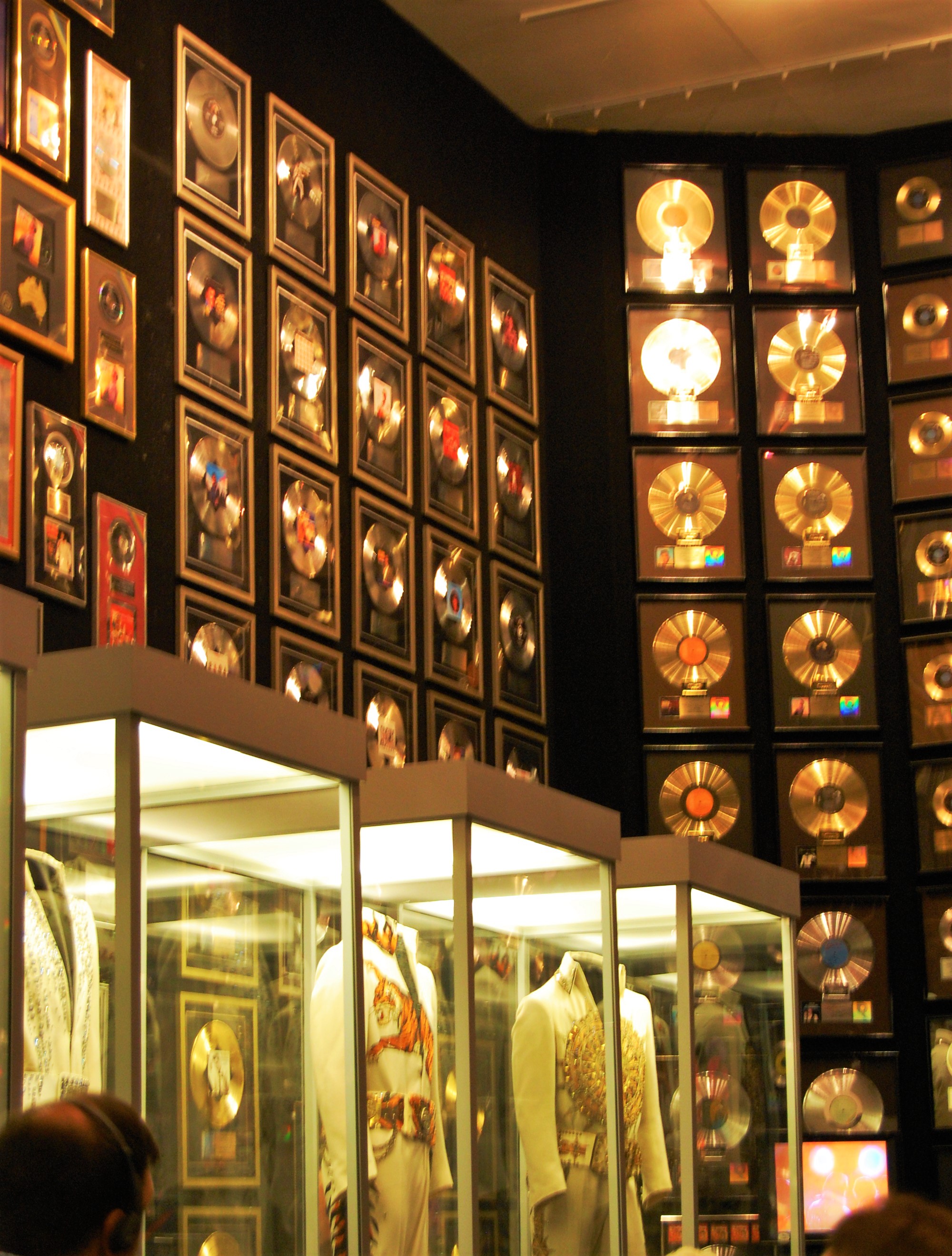
The Trophy corridor and room with Gold Discs and Elvis costumes

Vernon’s Grave

Elvis’s grave


Why is it that all the Elvis impersonators try and cover the wrong era? They all go for the later, older Elvis in his stupid rhinestone costumes and gaudy rubbish singing his trite Pop crap.
Is that because the Young radical Elvis is too hard to do? Is it because the fat Elvis is easier to impersonate and provides longevity to an impersonators career? Or is it because the vast majority of people have no taste?
The young Elvis was a revelation. He exploded on the scene with the smouldering good looks of a James Dean/Marlon Brando, the style of the wildest hep-cat, the music of the black geniuses, and the sexuality of an incarcerated cougar on heat. I can see why that might be difficult to copy! He was a one-off! His feline movements were raw, unadulterated sex. Nobody, white or black, had ever moved quite like that. The way he dressed with his long hair greased back into a quiff and duck-tail, sideburns he could tie under his chin, contrasting shirts, ties and jackets in whites, pinks and black, trousers so baggy you could see him move inside them like a bag of ferrets; it was so original that it sparked a revolution.
Why do none of the imitators try to capture a little of magnetic magic?
The older, fat Elvis was a ponderous parody in comparison. The songs, crooned and wailed, were a shadow of the energy of those early performances. Even the lip curl and sultry looks were practised imitations of himself. Elvis had faded into his own jaded tribute act. And as for the ‘Circus’ costumes – they were just there to take the attention away, to create a gaudy façade behind which he could perform. They were as fake as any clowns costume and twice as ludicrous.
Yet this sad, though still good, shadow of the supernova he started out as, is the one that everyone tries to ape.
Why?
And how sad!
T


This was written by Arthur Gunter and was more provocative and suggestive than any of Elvis’s hip swivelling.
My Nan used to play Housey Housey (Bingo) but that’s not what Elvis was singing about here. This was a song asking his woman to come back to him so that they could set up home or sleep together. This was no marriage proposal.
It puts the whole lie to Elvis’ protestations of innocence and his ‘good boy’ image. Elvis grew up in Tupelo from poor white farmers and subsistence farming. He hung around the black quarters in the wrong side of town. He’d been a truck driver. He knew what was going down.
This was a song about sex. This was the seminal, earthy Elvis, pushing the limits and bringing raw sex out of the black culture and straight into the living room of gentile white folks. It shocked the parents of those naïve, innocent apple-pie suburban parents but it sent a jolt of lighting through the groins of their children. It unleashed a storm.
All those young girls would do anything to play house with Elvis. He was sex on wheels and those wheels were those of a pink Cadillac.
Baby Let’s Play House
Well, you may go to college
You may go to school
You may have a pink Cadillac
But don’t you be nobody’s fool
Now baby
Come back, baby, come
Come back, baby, come
Come back, baby
I wanna play house with you
Now listen and I’ll tell you baby
What I’m talkin’ about
Come on back to me, little girl
So we can play some house
Now baby
Come back, baby, come
Come back, baby, come
Come back, baby
I wanna play house with you
Oh let’s play house, baby
Now this is one thing, baby
That I want you to know
Come on back and let’s play a little house
And we can act like we did before
Well, baby
Come back, baby, come
Come back, baby, come
Come back, baby
I wanna play house with you
Yeah
Now listen to me, baby
Try to understand
I’d rather see you dead, little girl
Than to be with another man
Now baby
Come back, baby, come
Come back, baby, come
Come back, baby
I wanna play house with you
Read more: Elvis Presley – Baby, Lets Play House Lyrics | MetroLyrics

When Elvis wiggled his hips he knew exactly what he was doing.
Elvis wasn’t the polite innocent he pretended to be. His act was pure sex. He chose to cover songs like Shake Rattle and Roll with their overt sexuality knowing exactly what they were about. Elvis was sex on wheels.
It was no wonder that the repressed prudish post-war generation were so up in arms, Elvis brought in a wave of liberalism and non-conformity that swept away all the grey fifties and heralded the rebellion of the sixties.
Black musicians like Joe Turner were already singing about sex and having a wail of a time. It was the white culture that needed to catch up. But the record company was a bit slow. They insisted he clean up the lyrics a bit. They didn’t like – Way you wear those dresses The sun comes shinin’ through I can’t believe my eyes All that mess belongs to you. They seemed to think there were sexual connotations.
There were.
Elvis opened the flood gate.
Shake Rattle and Roll
Get outta that bed
Wash your face and hands
Get outta that bed
Wash your face and hands
Well, you get in that kitchen
Make some noise with the pots and pans
Way you wear those dresses
The sun comes shinin’ through
Way you wear those dresses
The sun comes shinin’ through
I can’t believe my eyes
All that mess belongs to you
I believe to the soul
You’re the devil and now I know
I believe to the soul
You’re the devil and now I know
Well, the more I work
The faster my money goes
I said shake, rattle and roll
Shake, rattle and roll
Shake, rattle and roll
Shake, rattle and roll
Well, you won’t do right
To save your doggone soul
Yeah, blow, Joe
I’m like a one-eyed cat
Peepin’ in a seafood store
I’m like a one-eyed cat
Peepin’ in a seafood store
Well, I can look at you
Till you ain’t no child no more
Ah, shake, rattle and roll
Shake, rattle and roll
Shake, rattle and roll
Shake, rattle and roll
Well, you won’t do right
Yo save your doggone soul
I get over the hill
And way down underneath
I get over the hill
And way down underneath
You make me roll my eyes
Even make me grit my teeth
I said shake, rattle and roll
Shake, rattle and roll
Shake, rattle and roll
Shake, rattle and roll
Well, you won’t do nothin’
To save your doggone soul
Shake, rattle and roll
Read more at http://www.songlyrics.com/joe-turner/shake-rattle-roll-lyrics/#ZIBYjrD2mdiZ4Css.99


Rock ‘n’ Roll emerged as Rockabilly in the mid fifties. In some ways the advent of Rockabilly was the story of Elvis Presley but in reality he was the catalyst and catapult that sent the style stratospheric. The sound had been bubbling around for a few years just waiting for the right person and the right moment. Elvis hit the spot and brought it together. It probably would have coalesced without him but it wouldn’t have been the same.
Rockabilly was the merging of two quite separate styles – black R&B and white C&W. The imposed segregation of the southern States had created a separation of the musicians and styles. Both had developed in their own way to fulfil a need. Following the Second World War there was a change in mood. The country wanted good-time dance music. They’d had it during the war with the Swing Bands. The dance-halls had resounded to the bid-band style as the young people jitter-bugged and lindy-hopped. The black youth seemed particularly adept and the black GIs had certainly impressed the British girls during the war.
As with so many things there was a convergence from many different directions. Elvis happened to emerge as the focus.
There is much conjecture as to the first authentic Rock ‘n’ Roll recording. The fact is that there probably wasn’t one. The term ‘Rock ‘n’ Roll’ had been in use since the thirties in black slang where it was a euphuism for sex. It was used in a number of Black R&B records in the forties. Rockin’ was also used to denote something was really jumping.
The musical elements of Rock ‘n’ Roll were also coming together in a number of different styles simultaneously. As early as 1946 Arthur ‘Big Boy’ Crudup had recorded ‘That’s Alright’ and ‘So Glad You’re Mine’ as up-tempo electric Blues and Bill Monroe recorded his bluegrass version of ‘Blue Moon of Kentucky’. Louis Jordan was developing his electric Jump Blues band style with dance numbers like ‘Let the Good Times Roll’ in 1946 and the ‘Saturday Night at the Fish Fry’, with its chorus of ‘It was Rockin” in 1949. In 1947 Amos Milburn recorded ‘Down the Road Apiece’ and the following year ‘Chicken Shack Boogie’. Hank Williams, with his Honky-Tonk style, recorded ‘Move it on Over’ as early as 1947. The Jump-Blues experts had really begun to put the components together by 1947 when Roy Brown wrote and recorded ‘Good Rockin’ Tonight’. This was covered by Wynonie Harris who also recorded numbers like ‘All She Want To Do is Rock’ in 1949 in the new up-tempo Rock style. This was joined by Goree Carter who released ‘Rock Awhile’ and Jimmy Preston ‘Rock the Joint’. Before the fifties had even begun there was a whole plethora of ‘Rock’ songs coming from Boogie Woogie, Bluegrass, Honky Tonk, Blues and Jump Blues. But the earliest contender of all may well be Sister Rosetta Tharpe, with her electric guitar and the Gospel song ‘Rock me’ incredibly recorded in 1942!
The scene was set for the fifties with segregated audiences, radio stations and ‘Race’ records. It was ripe for a coming together.
Young white audiences were getting hip to the great sounds coming out of the black radio stations. They were digging the Jump Blues, Doo-Wop and Boogie Woogie they were hearing. Black kids and musicians were also tuning in to the white Country stations and liking what they were hearing. It only goes to show that you may segregate the bodies but you can’t segregate the minds.
In the fifties the Blues had electrified and taken on a heavy beat with Muddy Waters and Howlin’ Wolf, Elmore James and co. In Louisiana the R&B sound had come together with Fats Domino and Clarence ‘Frogman’ Henry. In 1950 Fats Domino released ‘The Fat Man’. Hank Williams and Bob Wills were producing up-tempo Country Music.
In 1951 Jackie Brenston, with the Ike Turner Band, released what some say is the first Rock ‘n’ Roll record with ‘Rocket 88’. In 1954 Joe Turner released ‘Shake Rattle and Roll’. You could even make the case for Bill Haley being the first white Rock ‘n’ Roller. He released Rock songs like ‘Rocket 88’, ‘Rock the Joint’ and ‘Rockin’ Chair on the Moon’ in 1951 and 52.
The ingredients were all there. The audience was eager. The times were right. The kids were looking for excitement, something different to their parents. Even the films were reflecting the age of rebellion with James Dean and Marlon Brando. The TNT had been put together all that was needed was the match.
That’s where Elvis came in.
In 1953 he walked into Sun studios in Memphis and made a demo. That young Elvis had been exposed to it all and had absorbed it like a sponge. He was full to bursting. In 1954 Sam Philips put him with two trusted musicians in Scotty Moore on guitar and Bill Black on Bass. The result was a series of searing tracks that created Rockabilly. The trio had no drums but created a driving, fast sound that drew on the R&B and C&W songs that Elvis was familiar with. He breathed a life into them that transformed them into something more. ‘That’s Alright, Mama’, ‘So Glad You’re Mine’, ‘You’re a Heartbreaker’, ‘Shake Rattle & Roll’, ‘I forgot to Remember to Forget her’, ‘Let’s Play House’, ‘Hound-dog’, ‘Mystery Train,’ ‘I forgot to Remember to Forget’, ‘Blue Moon’, ‘Blue Moon of Kentucky’, ‘Good Rockin’ Tonight’, ‘Milkcow Blues’ and ‘I’m Left, You’re Right, She’s Gone’ formed the basis of his live act and most were recorded for Sun. They were joined with some crooning ballads like ‘I Love You Because’ and the legend was off the ground.
Elvis was not only a great singer but also a brilliant performer. Elvis had the style that fashioned a revolution with his greased back long hair, long sideburns, duck-tail, contrasting bright jackets, shirts and ties, tight trousers, and smouldering looks – he had animal magic and charisma. He was incredibly good looking and moved his body sensuously in a way that nobody had seen. It was a mixture of dancing, posing, acting and raw sex with the fluidity of a large cat. It drove the girls crazy. He was called ‘Elvis the Pelvis’ because of his sexual gyrations. He also drove the parents and establishment into paroxysms of shock. Elvis was bringing the sexual vulgarity of black R&B into the white sitting room. The effect on their daughters was all too obvious. They were appalled. He was promptly banned.
However, the genie couldn’t be put back in the bottle. There was too much money to be made.
Every record label in the land was hunting for its own Elvis and the doors were even opened for the Black Performers.
From Sun Studios we got Jerry Lee Lewis, Carl Perkins, Roy Orbison, Billy Lee Riley, Sonny Burgess and Johnny Cash. From Chess in Chicago we had Bo Diddley and Chuck Berry. From New Orleans Fats Domino and Little Richard. From Texas Buddy Holly. Then there was Eddie Cochran, Ray Charles, Gene Vincent, The Everly Brothers, Wanda Jackson, and Dale Hawkins. It was like they all emerged ready-made. They exploded into the charts and a new age was born.
Allan Freed coined the term ‘Rock ‘n’ Roll on his ‘Moondog – Rock ‘n’ Roll’ Show. He championed R&B, Doo-Wop and Rock ‘n’ Roll. Was among the first to play it and organised the first Rock ‘n’ Roll concerts.
Elvis moved from Sun to RCA and took Colonel Tom Parker as his manager. For a couple of years we had the new Rock ‘n’ Roll complete with drums. The trio was ditched, the Jordinaires were used as vocal backing and then Elvis was eased over into a series of mediocre films and conscripted into the army. He had his hair and sideburns shaved and Lennon remarked that they cut his balls off with it.
By 1960 Rock ‘n’ Roll was through. The establishment had been horrified and quick to act. They thought it had a bad effect on the morality of youth and created delinquents. The authorities effectively shut it down using the ‘Payola’ scandal as an excuse. Radios were no longer allowed to play it. The TV stations moved over to the new ‘clean-cut’ boy next door, nicely presented in suits with trimmed hair Philadelphia Pop-Rock of Fabian, Bobby Vee, Bobby Darin and Bobby Rydell.
Chuck Berry was in prison. Elvis was in the army. Little Richard had discovered religion. Buddy Holly and Eddie Cochran were dead. Gene Vincent was badly injured. Jerry Lee Lewis was banned and ostracised because of his marriage to his thirteen year old cousin. Fats Domino had his records covered on the day of release by the clean-cut Pat Boone.
The energy and revolution petered out. Rock ‘n’ Roll was dead.
I visited Memphis and went to Sun Studios. It hadn’t changed. The ceiling was still up and down. They still had the old microphones. I stood on the very spot where Elvis had recorded ‘That’s Alright Mama’, all those years before. You could sense the energy and history.
It was incredibly nostalgic. My greatest regret is that Elvis didn’t have the self-confidence to reject Colonel Parker and the money, to turn his back on the films, and to stand up as a real angry James Dean rebel and stay with his music and his original trio. He rolled over. He watered his music down, tamed his act and became a parody of himself. He should have stayed true.
I wonder if Rock would have died?

My Elvis is the real version – the Hillbilly Cat of 1956-58, before he became a parody of himself and then got sucked into the vortex of mediocre Pop and pseudo-Rock created by the Film and Music Business.
The real Elvis didn’t wear silly rhinestone encrusted jumpsuits and capes more suited to carnival. He didn’t do his moves in predictable over-exaggeration to deliberately elicit screams from the girls. The real Elvis was as natural on the balls of his feet as a mountain lion. He instinctively knew what to wear, how to move to the beat, emphasise the rhythm and what sounded cool.
The fake plastic Elvis was deferential, self-conscious, overly polite and dictated to by management so that he became trapped in a cage of their making. I liked my Elvis aggressive, rebellious and assertive.
When he exploded on the scene with the force of the Big Bang a new universe was conceived. He was natural, unschooled and as unrestrained as a tsunami. There was nothing contrived about him.
Elvis wore his hair long, greased back into a big quiff and duck’s tale. It stood out amidst the prevailing crew-cuts of his days so that he was ridiculed at school. But Elvis had style and charisma to go with his natural good looks. He grew sideburns long enough to tie under his chin and wore contrasting colours – pink jackets, black shirt, white tie, baggy slacks, thick crepe shoes. He had a lip that curled into a snarl and a lopsided smile.
He was brought up in the poor part of Tupelo and mixed with the poor whites and blacks in that rural setting. It was here that he was exposed to the primitive Hillbilly and Blues that was going to form the backbone of his sound. He made little distinction between white and black despite the prevailing segregation in the South. He listened and watched the Black artists perform as much as the Whites. Good music was good music. Elvis went for the stuff that jumped both from the Honky Tonks and Blues Joints.
When he started performing he allowed his body to interpret the beat and act out the rhythm. He’d gyrate, shake, pivot and pounce as the mood took him. It was all primitive and natural.
That Hillbilly Cat rocked.
Those Sun recordings of 1956-7 displayed a whole new dynamic force at work. Rockabilly was born and was life transforming. Elvis took the Black and White music and gave it a beat of his own that brought it to life.
Sam Philips said he was looking for a Whiteman who could sing like a Blackman. He got something even more that that. Elvis was a phenomenon.
The establishment thought it was a novelty that would prove a passing phase. As far as Rockabilly went it was but what it spawned grew into a monster that threatened to swallow the whole industry and change the world.
Elvis had it all. He was an exceptionally attractive, sexy White guy who stole music off Black guys as well as White guys and gave it a bit of magic dust that snazzled it up into something else. He had the looks, style, moves and an original style that shook up all the kids. It couldn’t last.
Well for Elvis it didn’t. He was tempted out of the Cat clothes into fairground razzamatazz by the greedy colonel with no faith in the music. He was bedazzled by the film industry and dreams of being the new James Dean and then snaffled into tedious Teen rubbish with terrible soundtracks that sucked his energy, enthusiasm and talent like a vampire sucks blood. He became a parody of himself playing up to the screaming girls. When he began imitating himself he lost the groove and never got it back. It all fell apart. Even the songs dried up and he was replaced with a highly successful plastic imitation.
The Hillbilly Cat lasted a scant couple of years, had his head shorn in the Army, his soul extracted on the silver screen and his balls chopped off by poor management.
But what a legacy those few years left the world. It has never recovered. All the Youth Culture that followed has a big debt to Elvis.

Little Richard was undoubtedly the most raucous and flamboyant of the early Rock ‘n’ Rollers. His wild act and set the pace. His voice was the loudest and the best. His material was the most raw and rocking. Elvis copied a number of his songs which became Rock ‘n’ Roll standards – ‘Long Tall Sally’, ‘Tutti Frutti’, ‘Rip it up’, ‘Good Golly Miss Molly’, ‘Ready Teddy’ and ‘Slippin’ ‘n’ Slidin’’.
For a time he could not do any wrong.
I fell in love with him the first time I heard him and his first album ‘Here’s Little Richard’ got played to death in my house to the background shouts of ‘Turn it down’. I even went so far as to do a living jukebox at my school fete featuring me, my Dansette and Little Richard’s album. I played tracks on request for the princely sum of sixpence (2.5 pence). I made a few quid and Little Richard blasted out right over the school field all afternoon. There were plenty of takers.
Richard Penniman was something of a mixed up soul. He was a black bisexual man from the Deep South who had been brought up in the Bible Belt and had religion seasoned into him. It didn’t sit easy with his penchant for R&B (the music of the devil) and a love of orgies. He found it, like many others from the same region, hard to reconcile.
Richard started out in R&B after emerging from Gospel singing in the church. His voice and appearance created quite a stir but he was confined to the chitlin circuit and black record labels. That all changed in 1954. He signed to Specialty and produced the dynamite single ‘Tutti Frutti’. There was no looking back. That single set the tone and created a whole act. The R&B was jettisoned and the Rock ‘n’ Roll persona was adopted. He was wild.
In the fifties he vied with Jerry Lee Lewis and Elvis Presley as the King of Rock ‘n’ Roll. They were superb but Little Richard was on fire.
He made that cross-over to the white audiences and got his records played on white radio. You cannot emphasise what a big deal that was back in those shadowy days of segregation. He broke down barriers.
I watched him perform on BBC in the early sixties. I was about thirteen and my sixteen stone Nan was sitting next to me loving it. He stood at the piano, pounding it with his hands, bottom and foot. The sweat flew off him. His voice roared and the songs pounded. This was Rock ‘n’ Roll. It didn’t get any better than this. Little Richard was loud, aggressive and really rocked. His voice whooped and roared. Nobody came close.
With his great pompadour hairstyle, pencil thin moustache and great oversize suits he looked the part. The band were tight. Everything worked.
But that first brief fiery album and singles were about it.
On a tour of Australia an engine on his jet caught fire and Little Richard decided that was enough. It was a sign from God to quit his low-down ways. He threw his rings off the Sydney Harbour Bridge, gave up Rock ‘n’ Roll and went into Gospel singing and preaching.
Specialty had lost their star and tried vainly to recapture and recreate the style with singers such as Esquerita and Don and Dewy. The nearest they got was the brilliant Larry Williams.
In the sixties the allure was too great and Richard went back into Rock. But it was weird. The music scene had moved on. Rock ‘n’ Roll was no longer the rage. The Beatles were on the scene. Richard took on a most peculiar persona with sequins, heavy make-up and a strange hairstyle. He made his living doing live versions of his early Rock stuff with some new albums along the way. At one stage he even had Jimi Hendrix in his band. His act was still wild, his voice was still great, but he was no longer producing that raw Rock ‘n’ Roll and had this strange camp style that seemed at odds with the music. The act was almost a parody and send-up. You wanted to shake him and get him to go back producing the wild, raucous Rock of the fifties. There are times when it is not good to move with the times. It felt as if he was being pulled in different directions. Apart from the odd stand-out track there was little to get excited about. The music did not measure up to those 1950s monsters.
I saw him at a gig in Bradford in the 2000s and it was one of the strangest ever. Little Richard seemed split in three. There was one third great Rock ‘n’ Roll, one third camp acting (Oooh get outa here!) and one third preaching. I suppose that was the only way he could reconcile it all.
Little Richard was one of the early pioneers of Rock Music. He set the trend. His exciting style was the greatest of all. No other Rock ‘n’ Roller was as visceral. Little Richard put the dynamite in Rock ‘n’ Roll. We’ll remember those early days.