The Colonel and the National Front

The Colonel and the National Front


Back in 1970 Pete and I returned to college for our second year. Somehow, despite the hundreds of concerts and other essential interactions we had managed to pass the exams (with a retake or two for me). With our usual meticulous planning and panache we turned up on the first day expecting everything to fall into place. It went as could have been predicted. We couldn’t find a room to rent and were on the streets. After a night in a phone box we headed off to the Students Union to seek help. They kindly directed us to a squat on Ilford High Street. It was an empty shop. We were instructed to do a secret knock on the door and ask for ‘The Colonel’.

We found the place and performed his intricate knock that made me feel like one of the Goons in that sketch where they had to do a thousand knocks on the door.

We must have got the convoluted pattern right.

After a while there was shuffling the other side and a voice, in a strong Scottish brogue, asked suspiciously who it was. We explained who we were, who had sent us and that we were to ask for ‘The Colonel’.

We stood in the road as a great deal of clanking and shifting took place the other side of the door. It opened a slot and a rheumy eye looked us up and down. Seemingly content the door then opened to reveal a man with grey hair, a clipped moustache and big eyebrows. He was wearing a kilt. He ushered us in quickly and we passed through the door into a dim stairwell. The cause of the clanking was immediately obvious. Above the door was suspended a huge body of metallic junk with everything from bike frames to parts of prams. It must have weighed a ton. Anyone forcing their way in would have had the whole lot descending on their head. The Colonel was prepared for bother. He wasn’t a Colonel for nothing.

Welcome to the squat.

The squat was the Colonel’s home but he kindly operated as a temporary residence for the dispossessed. There were quite a lot of them around in the East End of London. Rachman was still in operation frightening people out of their homes and taking over the places to charge extortionate rents and pack in immigrants. He was making a fortune out of the misery of others.

The squat had a number of rooms. The Colonel had the front room. He was a Colonel from a Highland regiment and received his pension weekly. It was soon apparent as to why he was living in a squat. In one of the other rooms there was a young couple with a three month old baby. They looked terrified and tearful. It later transpired that they had been targeted by Peter Rachman. They had been renting a room in a house that the Landlord wanted. They been told to go but as they did not have anywhere to go to had ignored the warnings. One morning a bunch of goons arrived while the young man was out looking for a job. They had broken in, smashed up all their possessions, including the baby’s cot, and thrown everything out the window into the garden. They’d escorted mother and baby out to the street and then proceeded to smash the stairs with a sledge-hammer so nobody could get back up.

No wonder the family were terrified. They’d rescued what they could of baby clothes and possessions and ended up at The Colonel’s.

Pete and I were shown into a bare room with filthy floorboards. I put my new cream-coloured ankle-length sheepskin coat on the floor as cushioning (I never got it clean again) and unrolled my sleeping bag on top of it. Pete unrolled his on the bare boards. We were home.

We all gathered in the Colonels big room that overlooked Ilford High Street, talked and watched the shoppers from on high. On Friday the Colonel received his pension and proceeded to blow it on scotch whiskey which he drank from an old chipped white enamel mug with a blue rim. The more he consumed the merrier he got and then would serenade us with song. He had an amazing ability to add ‘Ne’ to the end of every word.

One song stands out:

‘Wunderbarne’

‘Meinne Pretyne Wunderbarne’.

It was quite a feat and we were all struck dumb with admiration, or at least we were struck dumb.

One Saturday morning we were subjected to a protest by the National Front against squatters. I bet Rachman was behind it. A huge threatening mob of Nazi’s appeared in the High Street, chanting, making Hitler salutes, pointing up at us and making threats. Between this menacing mob, who were busy working themselves up into a frenzy, and us was a thin line of police. It was getting extremely violent and explosive as the mob grew to a hundred or so and the fury mounted. It began to look as if the handful of police were going to be swamped and we were going to end up as mincemeat. In hindsight this probably wasn’t helped by Pete and I sitting in the window with our feet on the shop front that jutted out below us, waving to and mocking the obnoxious fascist skinheads who did not seem at all pacified by a couple of long-haired freaks grinning down at them. Peace and love were not in their repertoire. They were baying for blood.

The furore eventually abated and somehow the police managed to keep them from storming the place.

We were only there for three weeks before finding a room but it was an experience.

The week following our departure the Colonel was arrested for indecent exposure.

One Saturday morning he had been partaking of his Scottish elixir of life and decided it was a good idea to demonstrate his vocal skills to the Saturday morning shoppers. He’d clambered out of the window on to the shop front, mug in hand, and proceeded to serenade the shoppers below with renditions all most likely based around the magic syllable ‘ne’.

The shoppers were not as enthralled as we had been. One of the ‘disgusted’ ladies had reported the event to the police. By standing on the front of the shop the Colonel had clearly revealed to all and sundry exactly what Scotsmen wear under their kilts. At least one of them thought it wasn’t a pretty sight. The inflamed ladies of Ilford achieved what the National Front could not and the squat was shut down.


In the UK – paperback and digital:

In the USA in both paperback and digital:


My Days of Writing – An Anecdote

My Days of Writing


After I’d left college in 1971 my girlfriend (now wife) and I started out on our world tour by hitch-hiking and working as a dish-washer and waitress, respectively, in the States for three months. We had numerous adventures and arrived back penniless and glowing.

Reality intruded into our lives. I was hit with the realisation that I had to get a job in order to earn some money. The student grant was gone. The real world beckoned.

I worked as a road-sweeper, warehouseman, animal house and laboratory technician. That was good. I was filling in time until we could resume our travels and adventures.

I’d started writing and painting in 1970. Somehow I had this idea that I could be content being creative and get by. It was not to be. We had our children. I ended up teaching and loved every minute of it (barring a few). It suited me to the ground. I am naturally exuberant, quick with the repartee and have a touch of quirky humour. I was the rebel the kids got on with.

But the writing was addictive. I still harboured dreams of being a writer and would happily have typed away in poverty if I could have scraped a living. That also was not to be.

The teaching was fun and exhausting but I’d promised myself that I would always save some energy for creative projects. The ideas stormed in my head and I found myself scribbling them down in classrooms, staff meetings and journeys. I wrote book after book.

At first I eagerly sent them in to publishers and collected the rejection slips. When one was picked up to be professionally read it was a great day. When one got taken up for publication we bought the kids Christmas presents with the promised cheque. The cheque never arrived. Somehow we absorbed the debt and I no longer sent off the books.

I came home from work, played with the kids and got them to bed, watched an hour or two of telly and around ten or eleven I got down to writing. I wrote until two or three in the morning and was up the next day at seven. I’d do that for three months at a time until I had a novel finished. I then threw the manuscript in a drawer and recovered before starting out on the next.

By the time I retired I had amassed forty books. I’d had a couple of science things published with Oxford University Press but I’d saved my fiction, biography and other weird things for later.

My career blossomed and my radical ideas were taken on and produced outstanding results. I felt like I was running Summerhill. I became Head and proved that you could be outstanding while treating young men like human beings and developing their social awareness. The community was buzzing and the kids beamed. Respect, tolerance, love, empathy and responsibility blossomed. My energy was channelled into making the world a better place.

I promised myself that when I retired I would rewrite all my books and look to publishing them. That is what I am doing.

My retirement is being spent reading, writing and travelling. That seems ideal to me. I mix that with friends, relatives, our children and grandchildren, a spot of wine, a laugh, a lot of loud gigs, a bunch of photographs, an argument, a film and my blog. I just wish I had more time in the day, more energy and the exuberance of youth.

I have been retired four years and have rewritten and written twenty four books so far. I’m working my way through.

I have a cunning plan.

I will write up all forty seven. I will edit and proof, publish on Amazon and then look to market and publish properly.

I’m not looking for a new career. I’m quite content. I want a creative outlet. I want an audience. I want to express my ideas, thoughts and feelings; I want to give vent to my passions. I seem to need that.

I’m not looking for wealth and fame.

I do want to be noticed. I do want my ideas to be valued. I am crazy about Rock Music, Blues, Nature, Animals, Sci-fi, the Sixties, the Environment, Education and Science. My wife says I’m opinionated. She’s usually right.

I just want to change the whole world!

(I only hope I have enough time left!)

Lipher – My Pet Rat – an anecdote

Lipher – My Pet Rat


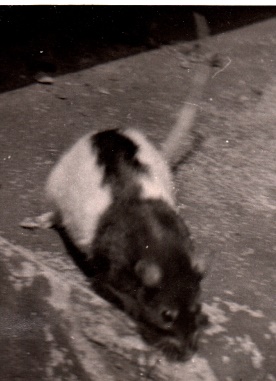
I was nineteen when I took custody of Lipher. She was a lively, loving black and white rat. Right from the start she was amazingly tame, affectionate and craved human company. She liked exploring and would come and snuggle up to you. Her way of greeting was to run up your leg, up your body and on to your shoulder where she would chunter into your ear and nibble your ear-lobe.

I lived in a single, pokey room that was shared with my friend Pete (who filled the tiny space with harmoniums, home-made mando-lutes and guitars). Lipher lived in a bird-cage on the side with the door open. She would sit on top of her cage and survey the room, or run around, climbing on every surface. If you left soap out she would pick it up and hold it in her paws like a squirrel and nibble it. She also had a penchant for tooth-paste.

I used to head off at weekends to see my girlfriend (now wife) and leave Lipher in the room on her own. When I came back she’d bound down off her cage and bounce across the room, claw up to my shoulder and chatter into my ear. She was so overtly pleased to see me.

One of the guys who lived upstairs collared me one day and said: ‘You do know that your rat always comes up to spend the weekend with us when you’re away?’ I didn’t know. But shortly after I left Lipher had worked out that I was off for a weekend, probably by what I was carrying, and made her way upstairs. She scratched on their door until someone let her in and then spent the weekend being pampered. She was always back before I returned. I’d have never known. It was as if she was psychic.

Lipher was a clever creature.

One day, in the midst of freezing winter, I’d returned after a weekend and Lipher bounded across the room. She stopped halfway and scooted off under the bed. I couldn’t figure it out. She’d never behaved like that before. It wasn’t until later, after I’d coaxed her out, that I discovered the reason. I’d left my new ankle-length sheepskin coat on the bed. Lipher must have been freezing; she’d chewed a hole in the coat and made a warm nest out of the fur. Somehow she had known it was wrong.

I used to take her out for walks. She’d sit on my shoulder, hiding in my long hair and peering out. She loved it.

One day I went in a baker’s shop. As a student with no money we were always going round looking for the stale bread and cakes or bacon ends. We scavenged. The shop assistance noticed Lipher’s little head poking out and beamed. She tickled her on the head and asked what she was. Was she a hamster? A guinea-pig? I told her she was a rat and the woman jumped back and screamed.

Lipher was one of the best pets I ever had – intelligent, affectionate and loyal. But rats only live two to three years and she developed cancer. I had to take her in to have her put down. I’ve rarely been more upset.

This was Lipher


She lives on.


In the UK – paperback and digital:

In the USA in both paperback and digital:
The Purpose of Life – Religion and Hardwiring.

I believe that to an extent religion is hardwired into our brains through evolution. We have evolved intelligence. Our success is our ability to see patterns and solve problems. There is a purpose to everything. That works great with hunter gathering. It enables us to work with the patterns of seasons and weather, to see the patterns of behaviour in predators and prey, to find water, to seek out fruits, berries and plants, to make tools, invent things and develop knowledge and technology.

This problem solving ability has enabled us to become masters of science and technology to the point where we are actually not only the predominant species but we are actually changing the whole planet. This is now the Anthropocene. Science and technology, stemming from our intelligence, our ability to see patterns and solve problems, has brought us control over our environment and all creatures. It has brought us agriculture and civilisation and enabled us to prosper in huge numbers – now pushing 8 Billion.

It falls down when confronted with the big questions that there are no answers for. Such as what is this immense universe? Where did it come from? What is life? Where did it come from? Am I immortal?

As I said at the beginning – we are hardwired to provide answers. We do not have answers to these and other such questions. They are too immense for our puny brains. Those brains have evolved to solve more mundane, practical problems. But that does not stop us from searching for answers and providing answers.

Early man was subjected to the vagaries of nature. If they could not find food through hunting or their crops failed because of unseasonal weather they starved.

They worshipped things such as the sun which gave life. They thought they could control it, appease the god they had created and performed rituals to please her. They performed rituals to produce rain, to have a good hunt, to harvest crops, for fertility, health and prosperity. They had holy men who could converse with the gods they had created. They invented explanations for the world, the sequence of life and death, creation myths and morality stories. They created reasons for when things went wrong and how they could put them right. They created fascinating tales of the afterlife to remove fear of death – death that was so prevalent.

They held great ceremonies, pageants and developed elaborate sacrifices and costumes. They built pyramids, temples and powerful spectacle.

The bigger and more lavish the greater the ease in believing in the story.

Through time these religions grew in sophistication and adapted as our knowledge of the universe and life grew. We see this with Christianity. In the beginning Hell was under the ground, Heaven was just above the firmament, the heavens were a dome. The stars chinks in that dome letting through the light of god, the sun rotated around the earth. As our knowledge grew these concepts were changed. We no longer look for hell under the ground or burn people for saying the earth goes round the sun.

We still cling on to the supernatural explanations though. Our minds have evolved to require answers. We still need to believe there is a purpose. Even in the face of no evidence we cling to the supernatural answers we find satisfying. They give us the assurance of order, purpose and answer our questions. They are much more psychologically satisfying than to accept there are no reasons, no order and no purpose. The universe just is. Life is an accident. We have a life and that is it. The only reasons we have are the ones we sort out for ourselves.

But I reckon that it is best to face up to the truth and accept it as it is. I see no evidence of god, an afterlife or a purpose for life.

Best to get on with it and enjoy it while we can. All we have is now. Let’s try to make this wonderful experience as good as we can make it, wring as much love, fun, creativity and pleasure out of it as we can and make the planet as good as we can make it for everybody else and all living things. That’s fulfilment enough for me.

Beat Poetry and Beatniks – An anecdote

Beat Poetry and Beatniks


I grew up in the sixties. I was too young to be a Beatnik of the fifties but their energy and vitality, their perspective, their anti-establishment fervour, their craziness and sheer exuberance suffused my spirit. I may have been a child of the wild sixties but my roots were firmly in Beat.

I was repulsed by the grey pointlessness of suburban life. It seemed devoid of colour, excitement or purpose. The whole boring spectre of work, TV, mowing the grass and washing the car seeming so dull and directionless was an anathema to me. When I hit my teens I wanted something more.

I had this overwhelming urge to break out of that pattern. I did not want to wear the same clothes, do the same things or have my mind fixed into some standard way of thinking.

I craved wildness, excitement and craziness. I had to think, to fly and to experience. I had a life and I did not want it filled with money, possessions or safety; I wanted it full of laughter, friendship, love, wonder and adventure. Memories were my wealth.

I gravitated towards the crazy people. I liked the weirder things.

At seventeen I was enthralled by my Rural Science teacher who spoke wistfully of his years living in a hut on Box Hill, getting up with the sun, doing a paper round to earn a living, growing his own vegetables, living frugally and having the day to do his thing. He was building a boat and taking a navigation course to head off round the world. I came out wide-eyed. My friends thought his was a loony.

I wanted to be a loony.

I knew which life I would have preferred. I’d prefer to be in a boat heading off into danger, adventure and uncertainty than working in an office and cleaning my nice car.

Then I read Kerouac and Ginsberg and discovered there were others out there who were outsiders, who saw society as a scourge, consumerism as an evil and wanted to pierce the fabric of life with their tongues, words, poems and lust. They saw life as a mad journey, a monster to be wrestled with, a vessel to be drained, an experience to be savoured and gleefully seized. Life was monstrously brilliant. You had to live in the moment and grab the ecstasy, sample the extent, let it explode and gush it back out in unleashed words.

These were no carefully crafted poems so much as splurges of words splattering like machine gun bullets into the grey matter to explode in ecstasies of enlightening understanding. They were ripping the fabric aside and revealing the naked truth underneath.

Life was to be lived. It wasn’t supposed to be comfortable, safe and boring. It was the ecstasy of being alive in the moment, in the midst of the crescendo of the raw universe. It was a wild, drunken, sex-filled

, journey into the unknown and it sang…. It sang… it filled the blood with fire….. it sent electricity through the brain…. It opened the eyes, ears and senses. Life had to be tasted, felt, smelt, seen, heard and thought and the revealed clarity had to be expounded in symbols and those words had to express the wonder.

That was the meaning the Beats gave to me. They took away my mundane existence and gave me life in full colour.


In the UK – paperback and digital:

In the USA in both paperback and digital:

Poetry – Allen Ginsberg and seeing the light – an anecdote

Poetry – Allen Ginsberg and seeing the light


Poetry was destroyed for me by school. Firstly in Primary school there was the emphasis on memorising great chunks of turgid verse.

Each week we would be given a long poem by Wordsworth or Tennyson to learn by heart. You were called to stand and recite a verse. If you had not learnt it you had to stay in and miss your Physical Exercise. Now PE was something I really looked forward to and although I had a good memory I could not always be bothered to memorise the meaningless drivel, which is what most of the poetry seemed to be to my young ears. Many were the afternoons I spent watching morosely out of the window while the rest of the class were outside enjoying themselves.

Poetry did not get much better in Secondary school. We analysed the metre, rhyme and metaphor until the whole process was just a bore, a mechanical process devoid of passion. I did not want it any more. The only highlight was the whole class excitedly chanting the Jumblies.

Poetry was moribund. It was the stuff of the old and dreary. It had no connection with my life or the world I inhabited. This was the sixties. There was loud music, parties, girls, motorbikes and excitement. Who cared about daffodils? I was young, wild and drinking in life. All that stuff pertained to a boring old world of long ago.

Then a friend gave me a copy of Howl. I was seventeen and the words leapt out at me. We were up against the establishment; a mouldering old set of values, a dreary, grey bunch of old fogies who were shoving careers and exams down our throats, who wanted us to settle down in suburbia, mow our grass, wash our cars and have two babies just like they had done. It wasn’t a vision that appealed. It looked drab. We were screaming for colour!!

We were alive and wanted to live, to burn and to run free. We didn’t want shackles, restraints and cages.

The establishment hounded us from all sides and we laughed in their face.

Suddenly there was a poem for us, for the rebels. I saw the best minds of my generation trying to smash out of the cage, trying to piss in their petrol tanks, put sand in their gear-boxes. We didn’t not want a passport into that mortuary they inhabited. We wanted to live.

Allen Ginsberg – here was a guy I could understand.

I’d been bopping through those same negro nights, high on life, talking my head off, shouting up at the stars, drunk on being.

I devoured Howl like it was ambrosia from the gods.

I had discovered Allen Ginsberg. Poetry had come alive. We were all angel-headed hipsters looking for a mystical connection to the universe; wanting to make sense of it all.

Life was a wild journey and we had to wring every last drop out of it.

No more lawns to mow, cars to wash or careers to follow – this was a mad saxophone wail into the torment of the cosmos and I wanted my soul to be in that wail. I wanted to live.

There was a mind to explore, limits to transgress and all possibility to challenge.

I knew I had people to meet, places to go and minds to explore. There was ecstasy out there. There was truth, Zen and a whole teeming inferno to discover!

I had discovered Allen Ginsberg and he had opened my eyes.

Poetry was communication on a level that made sense at last!

Poetry could be about real life!

Poetry had passion!

In the UK – paperback and digital:

In the USA in both paperback and digital:

Hat and the E-Type Jag – an Anecdote

Hat and the E-type Jag


When I was seventeen I lived at home. We had a bungalow and my bedroom was at the side. I was doing my A-levels, not that you’d know it, and life was quite wild. There was music, gigs, parties and friends. The sixties were in full swing. I had my motorbike and was as free as the wind through my long hair.

Hat was a good friend. His Dad owned a factory and had insisted he left school and worked in it to learn from the bottom up. That was not amusing Hat who found it all excruciatingly boring. They were quite wealthy, wealthy enough for his Mum to have an E-type Jag that she let Hat borrow.

Every now and then I’d be asleep and there’d be a knock on my window. It’d be Hat. He’d borrowed the car and fancied a drive. I’d climb out of my bedroom window and we’d head off into the night.

Sometimes we’d just drive around.

‘Where to?’

‘It’s always straight on!’

It became a catch-phrase. It would always take us somewhere though it wasn’t as good at getting us back.

Hat’s favourite destination was Brighton. We’d hurtle down the sixty miles to the sea-side, run up and down the pebbled beach like maniacs and then get back in the car and drive off.

It was pointless. That’s what made it so attractive.

For some strange reason the police would take an interest in our exploits. Two young men driving around in a flash E-type Jag in the middle of the night seemed perfectly normal to us but they thought we were up to no good. They seemed to think we’d stolen the car. Unreasonable eh?

Hat did not make it better and there were a couple of times when we ended up being taken in to the police station for questioning.

‘Is this your car, sir?’

‘No.’

‘Do you mind telling me what colour it is?’

Hat, peering out of the open window at the bodywork. ‘It’s hard to tell in these yellow street lights.’

‘Do you know what the registration number is?’

‘Haven’t a clue.’

Hat’s long-suffering Mum would get a call in the middle of the night and have to smooth things out with the disgruntled constabulary. Hat loved winding them up.

On the way home we’d always pop into Heathrow Airport. It was the only place open at that hour back then. We’d run up the long escalator marked ‘Down’ and get ourselves a coffee.

Hat would drop me off. I’d climb back in, get an hour’s kip and be into school the next day. Nobody ever knew.


In the UK – paperback and digital:

In the USA in both paperback and digital:

Bede and the Party – an anecdote

Bede and the Party


Bede is a good friend; I ended up sharing a flat with him in 1970.

The first time I remember meeting him was at his twenty first birthday party. He was completely naked running about all over the place. It was a strange party.

I had a car. It was an old Ford Popular sit-up and beg car that I’d painted. I’d used all the bright gloss paint I could lay my hands on. The grill was orange, body pink, lamps yellow, wheels orange with a blue stripe down the middle and various green trim. You could see it coming. It proved very popular with the police. They loved pulling me over and trying to find a problem with it. I had to take my documents in to the police station. I was on every page in the book.

A stone had shattered the windscreen and, as I didn’t have the money to replace it, I solved the problem by knocking the glass out. It made for a breezy ride but was good in summer.

I’d been out to a gig with Bede and after we were heading home in my rainbow car when Bede saw that the pubs were emptying. He told me to pull over.

Bede climbed out through the broken windscreen and stood on the roof. He announced that there was a party about to happen round at his place. It seemed to go down well.

By the time we got there people had started arriving. The only trouble was that Bede was not really set up for a party. There was no sound system, no drink, no food, but we had lots of people.

Soon the flat was heaving. They were very amenable. Bede and I randomly read extracts of books to great cheers. Before long spliffs started circulating, booze magically appeared, a sound system materialised and some good music started up.

It went on all night and developed into one of the best of parties. The only downside was that someone stole a couple of Bede’s shirts!

Crazy times.

In the UK – paperback and digital:

In the USA in both paperback and digital:

Support Democracy!! – We need a Second Referendum!!

What Union would go off to negotiate with their employer without going back to ratify the outcome with the membership?

None!

When the country went to vote on Brexit everyone had their reasons and nobody had a clear idea of what we were voting for. Now we do.

There were lies and false information.

What is quite apparent is that things have not turned out how we were assured they would.

We are looking at an outcome that is the least worst of the many possibles. Before we jump off the cliff I think we all deserve another vote.

Is this outcome what the Brexiteers wanted? I think not.

Some wanted sovereignty.

Some wanted control on immigration.

Some did not like the EU.

Some just wanted change.

Some were taken in by the promises and thought we’d be better off.

Some just wanted to kick politicians up the arse.

Different people wanted different things. Now the reality is exposed. Nobody realised the huge costs involved – the divorce bill, the cost of extra customs, the extra bureaucracy, the enormous costs of duplicating all the shared institutions and extricating ourselves from joint ventures. We will be doing immense damage to our economy. There are going to be tariffs, difficulty in movement and many firms are heading out to Europe. Brexit is a disaster.

People are beginning to wake up to the reality. It isn’t anything like the extreme right-wing Brexiteers promised. It’s not simple. It will leave us much poorer. It puts the union of the UK at risk.  It’s a mess.

On top of that there is no majority in parliament for any type of Brexit. We are in an impasse.

This whole Brexit stupidity has already done a great deal of damage to the country. It’s time to bring it to a head.

People are waking up. There is now a clear majority for remaining. It is time for democracy to break the impasse and put us out of our misery!

It’s time to allow democracy to do what the cabinet are incapable of! The Government is inept. Let the people decide!

Let’s have a second referendum and get it over with! Democracy is the key!

Slith The Snake – Anecdote

Slith the snake


Slith was my pet boa constrictor – all six feet of him.

I bought him on the spur of the moment for £40 that I really could not afford. But he came complete with vivarium. It was a bargain really.

Slith had had an interesting life in the entertainment industry. It appears that large snakes have some erotic import in the glamour industry. Slith had adorned the naked bodies of many lithesome ladies. He was a bit of a stud. There are probably a number of his photographs out there in cyberspace.

Slith liked people though he was not so keen on some women. He bit two of them. We think it was the perfume but perhaps it was a throw-back to his past life in the erotic sex industry?

Slith had to be fed on live mice.

The first time we did this we introduced the mouse into the vivarium and watched with interest. Slith coiled up around his branch and watched the hapless unaware creature. He flicked his tongue out to scent the animals. Then in a flash it was gone. The mouse was dead with a bite to the back of the neck and was wrapped in a powerful coil of snake.

We were relieved that it was so quick and painless. We were concerned that it was so quick that you did not see the strike. That made us nervous when handling him.

Slith was strong. If he wanted I reckon he could have broken your arm or strangled you. But fortunately he was friendly. He enjoyed being handled though that was probably our warmth.

You always knew when he was getting annoyed; he’d move his head from side to side. He was sighting up for a strike. Whatever you were doing; you stopped whatever it was you were doing and backed off.

He liked warmth and would often get out of his cage to wrap himself around the old wrought-iron radiator. Once he was wrapped around it you couldn’t prise him off. Once we found him coiled up in our bed when we went to bed. That gave us a bit of a start.

One of Slith’s favourite past-times was motor-bike riding; he could not actually ride one, of course, but he would wrap himself around me and I’d take him for a spin around London. He’d always hold his head up next to mine and face straight ahead into the breeze. The faster I went the more he stretched forward into the wind. He loved it.

I remember once pulling up alongside a London cabbie. He had his window open and looked over to find Slith peering at him from a foot away with his tongue flicking out. I’ve never seen a window go up as quick.

I left Slith with a friend while we went off on our travels. Unfortunately he bit someone and our friend became worried and gave him away.


In the UK – paperback and digital:

In the USA in both paperback and digital: