Beat Generation
The Beat generation was where it all started. They were 50s generation that began the process of rejecting the American Dream and looking for some alternative zen. Wasted and beat wading through the streets of America, talking Black jive, digging cool Jazz, smoking dope, taking peyote, careering through the highways of probability, scrawling poems on the inside of the skull.
Kerouac invented stream of consciousness and became the principle recorder of what was going on – raising the status of the hipness of black culture with its wild jazz and existential attitude. Seeing the horrors of American society, its conformity, war lust and seeking a crazy journey through zen into the cosmos beyond, in search of meaning, questioning existence. Kerouac whose tales of fire watching on mountain tops while seeking sartori and bumming round on boxcars or else storming around in cadillacs with crazy amphetamined lunatics, goofing on jazz, buzzing on marijuana and rockin’ in Mexican brothels, painted a new canvas of possibility for a whole generation. From the dull picture of conformity and the drabness of a lifetime of mind numbing work to a colourful alternative of wildness and crazy. Life could be as exciting and meaningful as the wailing saxophone solo of some black jazz musician who was reaching down to his very soul for inspiration as he blew. After Jack we all knew that there could be a different beat to life. That there was fire and craziness was fine, and there was a possibility of some greater rhythm behind reality, a rhythm that you could seek and connect to. From the constraints of his catholic upbringing he reached out to Zen. It’s true that he later fell back to the security of his mother, Catholicism and alcohol and died rejecting the son he had brought into the world. But that’s just sad.
A friend gave me a copy of ‘On the Road’ and I read it when I was eighteen. I wanted a car to roll around those back roads of Mexico. I wanted to ball around on speed, smoke marijuana in the heat, fuck and laugh with Mexican senoritas in bawdy bordellos, get pissed and yell and whoop to loud, loud jazz. The technicality of not actually greatly liking jazz was irrelevant. I was in love with the idea of it and what it represented.
Then Dharma Bums captivated me. I immediately wanted to get into Zen like Japhy. I wanted to ball around on boxcars, climb mountains, seek solitude and write poetry. I wanted to crack that code of life. Fuuuuuck!!!
Then Ginsberg, subject of obscenity charges for scrawling graphic homosexual imagery in Howl. Howl – the first poem that brought me back to poetry after school had destroyed it. And Ginsberg, an American Jew, writing great clouts of tirade against the monolithic state of America, the futility of civilisation, and the bankrupt souls of Western culture; Ginsberg, an outsider, daring to point fingers and show us an alternative way to live.
I was watching the best minds of my generation in the process of being destroyed. Where was the excitement? The possibility? The exploration of life, the soul and reality? They were being bored to death! We were being stifled before we had learnt to see. We were being locked in straitjackets, blinkered and taught what to think. Religion, education, society, careers, and our place. Suddenly there was a poem that was shrieking out loud about it. They were holding me down with a pillow over my face and suffocating the questioning out of me. Then along came Ginsberg and you were not alone in living under some fiery firmament that didn’t make sense. That the cosy church services did not make sense of. That it was a possibility to investigate reality and go crazy. That craziness was more sane than the insanity of this cosiness. The pillow was lifted and you could breathe a heady mix of uncharted stimulation. It was all up for grabs. You were well off the highway heading down the trails to the wilderness.
Ginsberg rescued poetry. It was again something that you could relate to purposefully. It spoke to my generation again. It wasn’t something you had to learn by rote and recite at request or suffer a detention.
And what of Burroughs who shot his wife through the head playing William Tell with an apple and wrote the naked Lunch and Junkie on an exploration through junk, peyote and yage. So far outside the cosy security of what my life seemed to have mapped out for me. Here were the squalid dreams, hallucinations and existence of a junkie. It was a totally different perspective on reality. Maybe not one you’d choose to pursue but one that had as equal a validity as anything else. That was what was important. We had broken out of the grey room. There was a universe out there and nobody understood it. Not only that but nobody seemed at all interested in exploring it. Everything was too safe! Yet there was no safety. The only thing you could be certain of was that you were going to die. At least these outsiders were fundamentally involved with grappling with the issues.
The eyes were opened to Corso, Ferlinghetti, Snyder and hundreds more. So where were our poets? Where were our equivalent of the American Beat Poets? Surely there had to be some British maniacs? Some British explorers of the soul and advocators of craziness? But Horrozitz, Pete Brown and Roy Harper were still a way off in the future and Adrian Henry and McGough were not far out enough to really compete.
Crazy outsiders and social misfits, explorers and seekers after different ways. That’s what was essential. Those were the credentials. Straight society might have its preoccupation with money, status and power through orthodox careers, status symbols, and your place in society, but we were looking to play a different game with entirely different rules. To play this game you could not use your present hand of cards. Those numbers did not add up. This was a hand of hip jokers. These cards won regardless of the others hand. Social position? Wealth? That wasn’t where it was at. The world was turned upside down. You aspired to be a black minstrel telling it as it was or a beat poet riding the blinds and seeking sartori, wild music, wild women and crazy stonedness in equal measures. The rules had changed.
The smokey Jazz cellars developed into the early 60s Folk scene. The hip talk, the dope and poetry were allied to Civil Rights, Anti-war and Socialism.
Dylan was adopted by Allen Ginsberg, who can be seen in the famous Subterranean Homesick Blues clip. The philosophy of beatness and Zen spilt through into the lyrics and life-styles. Dylan epitomised this. In his early incarnations he was a commentator on social, racial and political issues. He raised awareness of the senseless brutality and futility of war, of the racist suppression of blacks and the vagaries of the class system and social justice. In a slightly later incarnation he was a hip surrealist poet, amphetamine crazy, spouting and snarling Beat poems over a pounding, weaving background of strident rock.
In Britain poets like Roy Harper developed from Jazz poetry to acoustic guitar and contemporary acoustic word pictures. I wouldn’t even dare to insult it by calling it Folk. It may have come out of the Folk scene. It may have used the Folk scene. But this was a new thing. Dylan, Harper and hundreds of others were melding together poetry inspired by the Beats and modern day issues into a new type of music.
In New York Beats like Ed Sanders took it into street theatre and formed the Fugs. They staged happenings, like trying to levitate the pentagon. They took political stances. They used satire and send-up. They were sexually explicit. More importantly they were completely crazy and were not in the business of producing product for mass consumption and exploitation. What was more important was to express what you felt, connect with other like-minded people, have fun, and change the world in the process.
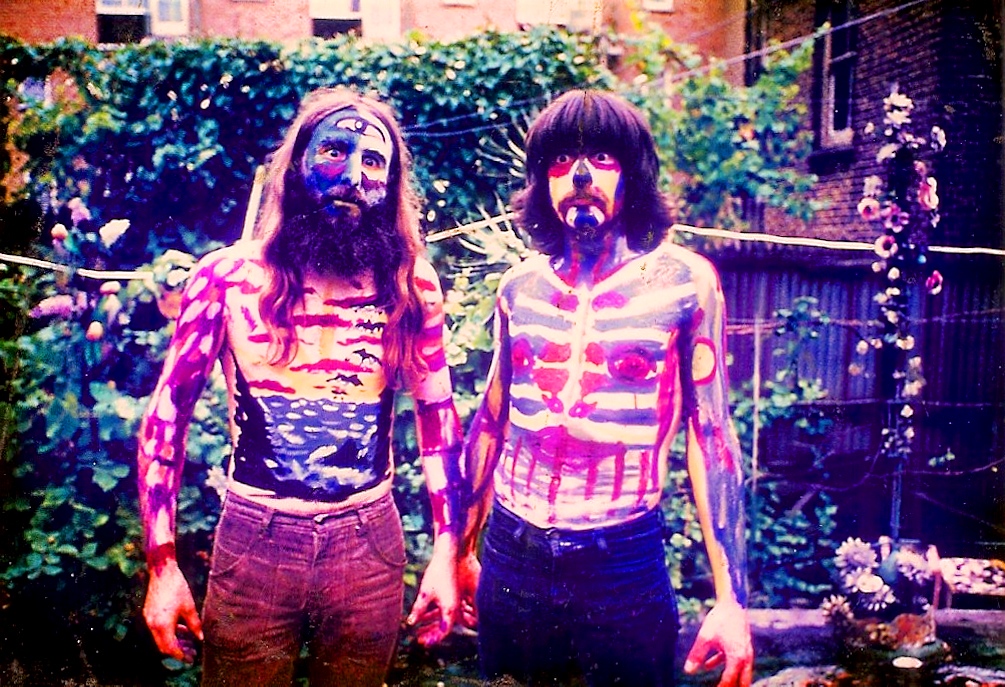
Out of the Beats grew the 60s underground, a linear progression. Not a fashion but a complete rejection of the social values and attitudes that straight society adhered to. Fuck the rat race. Life could have room to fuck, chill out, create, feel, express, love one another, seek mystical communion, experience reality and get stoned. It was alright. Fuck the Puritanism. It was time for new, more liberal rules.
If anybody is interested in this book I’ll put up the link.
That is the coffee table size.
I’ll do a new publishing at a smaller size which might work out cheaper! I know you’ll be dying to get your hands on it and can’t wait though.
Like this:
Like Loading...