
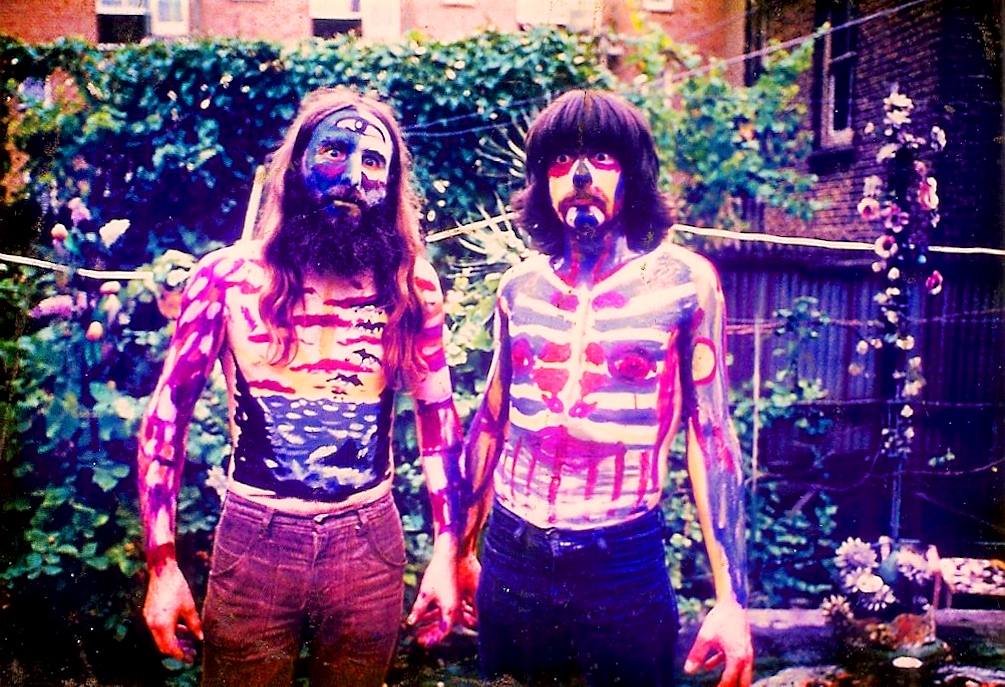
This is me (one the left) and Pete in 1971. Two ordinary lads making our way in the world.
Pete the inventor of psychedelic lights and musical instruments
Rooming with Pete was an eye-opener. He was an inventor. He did not set out to be. He merely failed to follow any rules, did anything he wanted, became thoroughly absorbed and obsessive about anything he was interested in, and did not have any limits. Pete was very unorthodox, bright and good at everything he turned his hand to. He refused to do anything the correct way and loved working out how to do things that had never been done before. It never seemed to occur to him that they might never have been done before for a very good reason.
One of Pete’s great obsessions was DNA. Back in the late sixties DNA was still very new and an expanding field. Pete was fascinated. He would read everything he could and absorbed the information through osmosis. He would come in to the tiny room we called home, and eagerly tell me all the latest information he’d discovered about the wonders of the guanine cytosine bond.
When it came to our finals we were both a little concerned. Going through my notes I discovered that I had only been to half the lectures. Not only that but they were all over the place. Out of a series of twelve I seemed to have attended lecture 1, 3, 6, 8, 10 and 11. It was an interesting exercise for those interested in number sequences but tended to create a lack of coherence when attempting to gain insight to the particular subject in question. It was the colleges fault. They insisted on putting lectures on in the morning. I ask you? After you’ve been out to a Roy Harper gig and up most of the night talking about infinity how are you possibly meant to get to a nine o clock lecture? I would have been OK if they had asked questions about Zoot Horn Rollo or Owsley but the bastards were so boring they stuck to stuff about biology. Now, don’t get me wrong, I love biology and animals, and through general immersion I had absorbed quite a lot of knowledge. That is why I had selected a biology degree. It wasn’t merely that it was a free three year ticket into the wonders of the sixties underground in London. Now I was faced with the bastards demanding that I took a whole series of examinations that were unimaginably hard. I was beginning to feel that I should have paid a little more attention, gone to a few more lectures, even possibly looked up one of the references in the library.The lack of notes made revising hard. Our last paper was a three hour essay. You had to know something to a great depth to manage a three hour essay at that level. I prepared two three hour essays on conservation and pollution. It was the year of the environment, that’s what I was interested in, so I convinced myself that this was what was sure to come up.
I turned over the paper and there was a list of six topics to choose from. Of course nothing I’d prepared came up. I had to choose ‘Light and Life’. I got by. But I did notice that Pete’s DNA was there.
‘You jammy sod,’ I said to him when we got out. ‘Your DNA came up. You must have hammered that.’
‘I didn’t do that,’ Pete replied. ‘I couldn’t have sat there for three hours regurgitating all of that. I did one of the others.’
That was typical of him. He could not cope with being bored. He had to be doing things. We were on a Biology course but Pete was more interested in building musical instruments or designing light shows. Our tiny room was full of strange shaped instruments that Pete had designed. There were mandoyukes, yukobanjes, balaiatars, and guitobanjies. There were fretsaws, glues, varnishes, inlay knives, sawdust, sheets of plywood and various parts of scavenged instruments – keys, strings and frets. Each instrument was a different shape and produced a unique sound. For Pete designing them was endless fun. Then there were the collection of harmoniums that he was supposedly restoring, all piled in the end of the room exuding a flurry of woodworm when you walked past. Centre stage were weird revolving drums that sprayed polarised light over the walls. He’d discovered the wonders of polarised light in the year of our finals. It was a subject more fascinating than sitting through lectures. If you obtained sheets of polarised transparent plastic you could shine a light through it and get coloured effects. By changing the angle you could get light to come off and on. Pete became captivated with designing slides that would produce strange changing colour effects. He bought a motor and placed a sheet of polarised transparent plastic in it so that it slowly rotated. He made slides out of polarised plastic. When he put the rotating drum in front of the projector he obtained all these metamorphosing colourful patterns – light houses that came off and on and scintillating psychedelic scenes. They were spectacular.
All of this incredible output of random creativity was condensed into a room that was hardly larger than the bathroom I currently possess. When you consider that we had to fit two beds into the place and have room for all our possessions and any social interaction we might desire you can see that the place was a trifle cramped, not that we saw it that way. We thought it was interesting. I don’t think anyone coming into our tiny domain would have come to the conclusion that we were two students engaged on a biology course. They would probably have thought we were doing woodwork, selling ethnic instruments or engaged in a social experiment.
Where other students on the course were producing essays, studying, revising and checking out the references in the library, Pete and I were listening to music, partying, meeting our girls, digging the scene, creating posters, musical instruments and works of art or reading Sci-fi. There wasn’t much time for fitting the college work in. Life had to be invented. We lived in the moment without plans or thoughts for the future. We were guided purely by our desires and interests.
Those were special years – living with a magic inventor.
If you enjoy my poems or anecdotes why not purchase a paperback of anecdotes for £7.25 or a kindle version for free.
Or a book of poetry and comment:
Rhyme and Reason – just £3.98 for the paperback or free on Kindle
My other books are here:
http://www.amazon.co.uk/Opher-Goodwin/e/B00MSHUX6Y/ref=sr_tc_2_0?qid=1457515636&sr=1-2-ent
Thank you and please leave a review.
Where is he now?
Pete is in Australia causing havoc and running a Wild Science alternative science education that he invented.
Do you still keep in touch.
Oh Yes. We met up for a big adventure in the outback a few years back and Pete and his wife came over for a big tour of Scotland with us two years ago. We’re going to head off back to Australia at some point. Pete is a genius.
Told with your usual relish – such characters are our secular saints, I would suggest!
Aaah! I see the mind is working to create this secular religion. What a good idea. We can have a set of seculsar saints. You are a genius Dave.
Cheers, Opher, wish I was then it might be easier to work out what I’m trying to do! There seem to be many obstacles to perceiving life as something holy – dulling routine, supernatural escapism and xenophobic militarism, for example – and I suppose the first thing to acknowledge is that we’re all susceptible to the fears that create the obstacles. Our connections with other people and with nature are crucial to a creative viewpoint. According to Basho, this requires ‘a mind to obey nature, to be one with nature, throughout the four seasons of the year’. That was written over 300 years ago, before the industrial revolution, so it won’t be easy to recover such simple reverence …
Well I think relationship with nature is a good basis for a secular religion. Perhaps we should focus our minds on some people who we might wish to canonise as saints of the new secularism. I’ll put my thinking cap on.